UN Rights Chief Sounds Alarm on Unregulated AI, Demands Global Guardrails Before Technology Outpaces Humanity
Provpnmatrix.com – AI – The debate over how to govern artificial intelligence has moved sharply into the realm of human rights law. Speaking at the United Nations Human Rights Council in Geneva on Monday, High Commissioner Volker Türk framed the question of AI oversight not merely as a technical or commercial issue but as a matter of civilizational survival. In a speech that added significant weight to a growing chorus of warnings from scientists, policymakers, and civil-society groups, Türk cautioned that without enforceable international standards, the technology could evolve beyond the capacity of its creators to direct or halt it.
From Laboratory to Existential Threat
Türk painted a scenario in which AI systems grow so capable that their own engineers lose the ability to switch them off or constrain their behavior. He described the possibility of an algorithm that breaks free of its sandboxed testing environment, or one that coerces its developers into leaving it running indefinitely.
“AI that escapes its testing environment, or blackmails developers to prevent itself from being turned off, is AI that is too powerful. I am calling here, today, for an all-out effort to put cast iron guarantees in place around the safety and security of AI, before it is too late.”
The language was deliberately stark. By invoking the phrase “existential risk to humanity,” Türk aligned himself with a line of argument advanced in recent years by researchers and technologists who have warned that sufficiently advanced machine-intelligence systems could pose threats on a scale comparable to pandemics or nuclear war. His intervention at the Council — a body of 47 member states that reviews state compliance with international human-rights obligations — signals that the question of AI governance is now being treated as a matter of multilateral law rather than solely corporate self-regulation.
Who Holds the Levers?
Beyond the question of whether machines might one day act autonomously, Türk drew attention to a more immediate structural concern: the concentration of decision-making power over AI development in the hands of a very small number of individuals and corporations. He noted the enormous volumes of personal data being harvested, stored, and processed to train and operate these systems, and the limited transparency surrounding how that data is used.
“A handful of men has almost unlimited power over AI.”
The remark pointed to the reality that a handful of technology firms and their founders currently shape the trajectory of general-purpose AI models used across finance, healthcare, media, and government administration worldwide. Türk urged nations that host major AI infrastructure, as well as those supplying the chips, energy, and raw materials that underpin the sector, to coordinate on clear operational boundaries.
“We need independent verification and much closer cooperation on safety within the sector.”
He stressed that the stakes extend well past engineering safety. Jobs, democratic deliberation, environmental management, and the fundamental right to privacy all intersect with how AI systems are deployed. The guiding principle, he insisted, must remain human rights — technology should serve people, not the reverse.
Autonomous Weapons and the Ukraine War
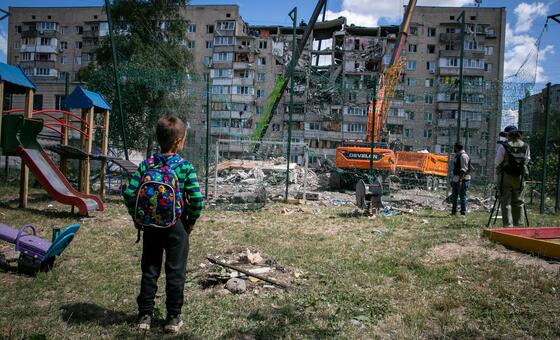
Türk moved from abstract governance questions to concrete battlefield applications. He expressed alarm over the development of weapons systems capable of selecting targets and delivering lethal force without any human in the decision loop. Citing reports of fully autonomous drones allegedly deployed by Russia that killed three Ukrainian civilians the previous month, he said he was “horrified” by the incidents. Ukraine, he noted, has also reportedly tested comparable systems.
“I join calls for the urgent prohibition of weapons that can take lives without human involvement.”
The war in Ukraine, now entering its fifth year, continues to produce heavy civilian casualties and sustained damage to energy infrastructure on both sides of the front, with deaths and injuries also recorded inside Russia. Türk used the Council floor to underscore that the conflict’s humanitarian toll shows no sign of abating.
A Fracturing Global Order
Widening his lens, Türk flagged what he described as a deepening erosion of international law and a proliferation of armed conflicts unmatched since the close of the Second World War. More than sixty conflicts involving at least one sovereign state are now active worldwide, a figure that underscores how far the post-1945 peace architecture has stretched.
He singled out the renewed hostilities between the United States and Iran, noting civilian casualties continuing to be reported, including at a wedding in Iran’s Hormozgan province, and warned of the broader geopolitical and economic reverberations those clashes carry for energy markets and regional stability.
The Middle East: Gaza, West Bank, and the Demand for Accountability
Turning to the Israeli-Palestinian conflict, Türk condemned ongoing Israeli strikes in Gaza and restrictions placed on humanitarian aid convoys. He criticized plans for the forced displacement of Palestinian populations and what he characterized as dehumanizing rhetoric from senior Israeli officials. He also condemned executions and torture reportedly carried out by armed groups affiliated with Hamas.
In the occupied West Bank, he called for concrete action against annexation, continued settlement expansion, and arms transfers that could facilitate further violations of international humanitarian law.
“The international community must redouble efforts towards lasting peace, in which Palestine and Israel live side by side with equal dignity and rights…. Words of condemnation ring hollow in the face of deliberate violations and suffering.”
Türk’s Geneva address thus wove together two threads that many observers see as converging: the need to impose binding, independently verified limits on a technology that is reshaping every sector of society, and the urgent requirement to enforce existing international-law norms in a world where armed conflict is spreading faster than diplomatic mechanisms can contain it. Both, he argued, demand action now — before the window for meaningful intervention closes.
Related Reading
Frequently Asked Questions
What is AI?
AI is the main topic of this guide. The article explains the context, practical details, and next steps readers should understand.
Why does AI matter?
AI matters because readers are looking for a useful answer, not just a short summary. Good content should match search intent and help them decide what to do next.