Families in Gaza City Face a Shrinking Space to Live
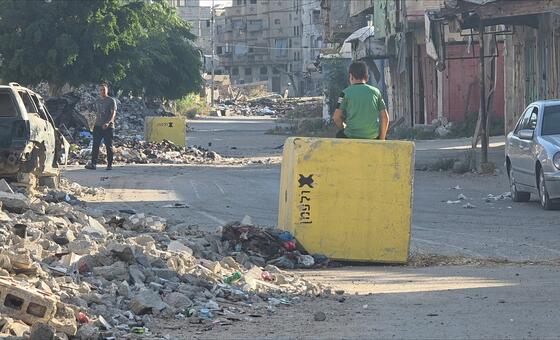
Provpnmatrix.com – In eastern Gaza City, painted concrete blocks have become a stark marker of uncertainty for families already uprooted by war. The yellow-painted barriers, placed by Israel near homes in areas such as Al-Tuffah and Zeitoun, identify the boundary known as the “yellow line” — a dividing line that has increasingly narrowed the area available to Palestinian civilians.
Ola Ishtiwi sits with her children beside the ruins of their home in Al-Tuffah, only metres from the blocks. For families living close to the boundary, daily life is shaped by the fear that the line may move again and force another hurried departure.
“We don’t know what to do or where to go. We don’t have a tent, and we don’t have money.”
The yellow line was introduced after the Israel-Hamas ceasefire agreement announced in October 2025. It divided Gaza into two zones: a western section where most Palestinians live and an eastern section under Israeli military control. At its outset, the civilian side covered about 47 per cent of the Gaza Strip. Israeli forces have since moved the boundary inward, leaving Palestinians living on less than 40 per cent of Gaza’s total land area.
Repeated displacement near the boundary
The reduction in accessible territory has placed greater pressure on neighbourhoods near the line. Some residents remain because they have no viable alternative, despite the risks of living close to an area affected by military activity. Al-Tuffah and Al Zaytoun, both in eastern Gaza City, are among the communities where families face this difficult choice.
Ibtisam Malika, who lives in Zeitoun, described a pattern in which households are displaced, return to what remains of their homes, and then are forced out again.
“Every two to three months, we are forced to move and leave our belongings behind,” she said.
“We can’t take it anymore. We lost half of our children in the war, and only remnants of us remain.”
About 2.1 million people — almost Gaza’s entire population — are displaced within the boundaries of the yellow line. The number illustrates a central reality of the crisis: displacement is not limited to a single movement from one place to another. For many people, it has become an ongoing condition, with belongings, shelter and family routines repeatedly disrupted.
Safaa Mushtaha, a resident of Al-Tuffah, said the question of where her family could go has become unavoidable.
“‘Where do we go?’ This is a question we’ve been asking ourselves for three years,” she said. “We accepted living near the yellow line, but it’s become unbearable.”
The concern is not only the possibility of leaving home, but the lack of safe and practical places to relocate. Land suitable for camps is increasingly difficult to find because much of it lies in prohibited or restricted areas to the east, south and north beyond the yellow line. This leaves displaced families with fewer options even when their current locations become unsafe.
Shelter needs deepen across Gaza
Nearly 1.98 million people, representing 94 per cent of Gaza’s population, require shelter and non-food assistance. The need includes basic items that help families endure displacement, as well as materials needed to create or repair temporary places to live.
Conditions inside many makeshift shelters remain extremely harsh. Eighty-four per cent of families are living in inadequate circumstances, including tents and other structures that do not sufficiently protect them from changing weather. A tent may offer a minimal degree of cover, but it does not resolve the wider problems created by overcrowding, repeated movement and the loss of household resources.
For people without tents or money to secure alternatives, each warning of renewed danger carries added weight. The destruction of homes means that returning is often not a return to normal life. It can mean staying near damaged buildings, sleeping in exposed conditions and preparing to leave with little notice.
Ahmed Arhim, also from Zeitoun, said the insecurity has affected children in particular. Gunfire and drones, he explained, make rest difficult and intensify fear inside families already living with displacement.
“The children can’t sleep. They are scared and they wet themselves. Many residents have already left. We are displaced every day, always displaced. This is not life.”
Ceasefire has not ended the danger
These accounts come as UN agencies continue to record Israeli military operations and strikes in Gaza despite the ceasefire announced in 2025. Local authorities have registered 1,334 deaths and 4,429 injuries since the ceasefire was announced on 10 October 2025.
The continuing violence has reinforced the insecurity felt by residents near the yellow line. In a five-day period late in August, Israeli attacks killed 24 Palestinians, including four children and one woman. Air strikes accounted for 21 of those deaths.
The situation demonstrates why the yellow line is more than a geographic marker. Its movement affects access to homes, shelter, land and the possibility of finding safety. Families living beside it are not only confronting a changing boundary; they are trying to preserve a place to live in a territory where available civilian space has steadily contracted.
For Ishtiwi, Malika, Mushtaha and Arhim, the consequences are measured in sleepless nights, abandoned possessions, damaged homes and children living with fear. Their shared question — where to go next — remains unanswered as displacement continues to shape life across Gaza.
Related Reading
Frequently Asked Questions
What is Where do we go?
Where do we go is the main topic of this guide. The article explains the context, practical details, and next steps readers should understand.
Why does Where do we go matter?
Where do we go matters because readers are looking for a useful answer, not just a short summary. Good content should match search intent and help them decide what to do next.