Guterres urges institutional reform for a changing global balance
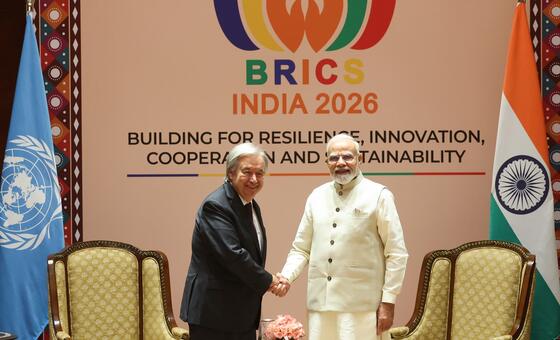
Provpnmatrix.com – Addressing leaders gathered in New Delhi on Sunday, UN Secretary-General António Guterres called for a redesign of international institutions created in the aftermath of the Second World War, arguing that they no longer fully reflect the distribution of economic, demographic and political influence in the world.
His message came at a summit of a bloc that includes Brazil, Russia, India, China and South Africa, along with other countries that have joined the grouping. Established to amplify the influence of leading developing economies, the bloc has become a prominent forum for countries seeking a stronger role in global decision-making traditionally shaped by Western powers.
India hosted this year’s meeting, which brought together heads of state as well as the leaders of the World Health Organization and the World Trade Organization. Guterres said the gathering itself illustrated the wider transformation underway in global affairs.
“Today’s economic, demographic and geopolitical realities are not those of 1945. Our institutional structures must reflect it.”
A multipolar world and the case for reform
The Secretary-General said the movement toward a multipolar international system should be viewed as an opportunity to make global governance more balanced and fair. But he stressed that a shift in power alone would not automatically produce better outcomes for countries or communities.
“Countries represented at this Summit speak to that changing reality,”
He said the world is increasingly becoming multipolar, and argued that international bodies must evolve alongside that change. In particular, he highlighted the UN Security Council and the Bretton Woods system, the post-war financial architecture associated with institutions including the World Bank and International Monetary Fund.
For many developing countries, the debate is not simply about representation. Decisions taken in these institutions can influence access to financing, responses to debt pressures, international peace and security, and the capacity to respond to climate disasters. Guterres presented reform as a practical requirement for institutions that want to retain legitimacy and effectiveness.
“Multipolarity helps bring balance and equity to global systems and institutions.”
He added that this potential depends on reforms that ensure today’s world, rather than the geopolitical arrangements of 1945, is reflected in the way global institutions operate.
Four priorities for inclusive growth
Guterres organized his appeal around four connected areas: development finance, technology, climate justice, and peace. Together, he said, they form the basis for more inclusive global growth.
On financing, he said developing countries require major international backing if they are to achieve the Sustainable Development Goals. The goals cover a broad range of global development priorities, from reducing poverty and hunger to improving health, education and environmental protection.
He urged multilateral development banks to become “bigger, better and bolder,” signaling the need for institutions with greater capacity to support countries facing large development needs. The call reflects a wider concern that available financing is insufficient for many countries trying to invest in infrastructure, public services, climate resilience and long-term economic opportunity.
Technology was another central theme. Guterres warned that artificial intelligence could deepen existing inequalities if access to its benefits remains concentrated among a small number of corporations and countries.
“Its power sits with a few companies, in a few countries. Unchecked, the AI divide will widen every other divide — in income, in opportunity, in security, and in sovereignty.”
The warning places AI within a wider discussion about global development and national autonomy. Countries without comparable technical resources, computing capacity or access to advanced systems could face added disadvantages as artificial intelligence becomes more important across economies and public life.
Climate funding and critical minerals
Guterres also delivered a forceful appeal on climate change, pointing to extreme heat, glacier loss, wildfires and floods as evidence of worsening risks. He warned that a supersized El Niño could intensify the situation as the world nears the 1.5-degree threshold above pre-industrial temperatures.
“Scorching heat, devastating glacier melt, raging wildfires, devastating floods are all a preview.”
He called on wealthier countries to meet commitments that include $300 billion annually, tripling adaptation finance and increasing support for loss and damage. Adaptation funding is intended to help vulnerable countries prepare for and cope with climate impacts, while loss and damage funding addresses harms that cannot be avoided through adaptation alone.
The Secretary-General also raised concerns about the extraction and management of critical minerals, materials increasingly important for energy technologies and other industries. His message was blunt:
“Enough plundering.”
The remark underscored the argument that countries supplying these resources should not be left with environmental costs and limited benefits while others gain from the global transition to cleaner technologies.
Peace, sovereignty and multilateral cooperation
Turning to conflict, Guterres cited Gaza, the broader Middle East, Ukraine and Sudan. He urged governments to respect the principles of the UN Charter, including sovereign equality, territorial integrity and the peaceful resolution of disputes.
His closing appeal linked institutional reform to the preservation of multilateralism. Rather than treating reform as a concession to emerging powers, he described it as a shared responsibility for all countries navigating a lasting shift in global influence.
“As we move irreversibly to a multipolar world, all countries must work to strengthen and safeguard a multilateral system that delivers for all with the United Nations at its centre.”
The challenge, in Guterres’s view, is to ensure that a more diverse distribution of power leads to more effective cooperation. That will require institutions able to address development gaps, technological inequality, climate pressures and armed conflict with credibility across both developed and developing nations.
Related Reading
Frequently Asked Questions
What is Guterres?
Guterres is the main topic of this guide. The article explains the context, practical details, and next steps readers should understand.
Why does Guterres matter?
Guterres matters because readers are looking for a useful answer, not just a short summary. Good content should match search intent and help them decide what to do next.