Yemen conflict forces nearly 100,000 people from their homes as aid routes come under strain
Provpnmatrix.com – Fighting that intensified in Yemen earlier this month has uprooted 93,864 people across the country, deepening an already severe humanitarian crisis and placing fresh pressure on communities receiving displaced families. The violence has spread across Aden, Al Hodeidah, Abyan and Ta’iz, underscoring the widening reach of the conflict between Saudi-backed Yemeni Government forces and the Iran-backed Houthi militia.
With nearly half of Yemen’s population of 41 million already in need of humanitarian assistance, the latest displacement comes as acute hunger continues to worsen. Families leaving their homes require immediate shelter, safe water, sanitation, food, healthcare and protection, while the places receiving them face growing demands on limited services.
Families leave with little warning
The International Organization for Migration has called for urgent assistance to help newly displaced people meet their most basic needs. Many households have had little time to prepare before moving to safer areas, often arriving without enough belongings or resources to begin again.
“Many families fled at short notice with few belongings,”
UNHCR has warned that displacement within Yemen could rise further if hostilities continue to escalate. Shelter sites and host communities are already under considerable strain, making it harder to ensure that families can access food, clean water, medical treatment and protection services.
Humanitarian operations are also being complicated by insecurity, damaged roads, restrictions on movement and interruptions to telecommunications. These obstacles are particularly serious on the western coast and along routes linking Ta’iz, At Turbah and Aden, where aid agencies must navigate difficult conditions to reach people in need.
Damage at Al Makha port has added another constraint to the movement of humanitarian cargo and personnel. Ports, roads and communications networks are essential to relief efforts in Yemen, where supplies must often travel long distances before reaching communities affected by conflict or displacement.
Crossing the Bab el-Mandeb Strait
The consequences of the violence are extending beyond Yemen’s borders. In just four days, rapidly worsening hostilities along the western coast pushed more than 2,400 people across the Bab el-Mandeb Strait to Djibouti. More than 60 per cent of those arriving are women, children and older people, and indications suggest that further departures may follow.
The crossing highlights the immediate danger faced by civilians seeking safety. The Bab el-Mandeb Strait connects the Red Sea with the Gulf of Aden and is one of the region’s most important maritime passages. For people fleeing Yemen, it can offer an escape route, but the sea journey itself is difficult and distressing.
“People are arriving after a difficult sea journey, many exhausted, distressed and carrying what little they could take with them,” said Sandrine Desamours, UNHCR’s representative in Djibouti. “The response is already under pressure. We urgently need more support before more families arrive and needs outpace our capacity to assist them.”
Djibouti’s response is being tested by the rapid arrival of people needing immediate support. Assistance must address urgent physical needs while also helping families who have experienced sudden flight, separation and uncertainty about what will happen next.
Threat to regional aid shipments
The escalation has also raised concern over shipping routes used to deliver emergency supplies. Continued insecurity around the Bab el-Mandeb could disrupt humanitarian and commercial vessels serving Yemen, Sudan and other crisis-affected areas. Any major interruption would add to existing pressures on global relief logistics, which have already been affected by disruptions around the Strait of Hormuz.
“Continued insecurity could affect humanitarian and commercial shipping serving Yemen, Sudan and other ongoing emergencies in the region and beyond,” UNHCR said.
Delays at sea can have serious consequences for humanitarian operations, especially where supplies are urgently needed and transport costs are already high. A deterioration in security could require vessels to sail around the Cape of Good Hope instead, extending voyage times by an estimated 25 to 30 days. Such rerouting could delay critical relief items and increase the expense of getting them to affected populations.
UNHCR has put mitigation steps in place, including emergency supplies already heading toward the area and potential overland deliveries from global stockpiles in Dubai and Nairobi. These preparations are intended to preserve the flow of assistance if maritime routes become more difficult to use.
Emergency response continues
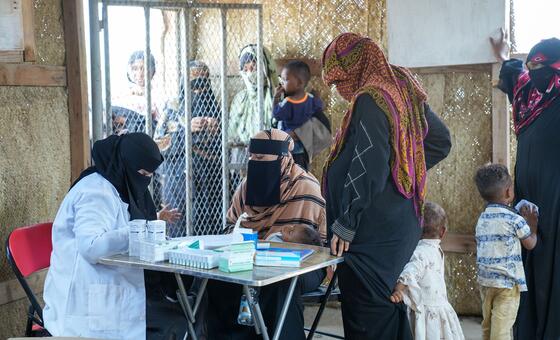
Humanitarian agencies are working across Yemen while monitoring how the conflict shifts and where people are moving. UNHCR, which leads the inter-agency effort on protection, shelter and site coordination, is supporting its partners’ work through cash assistance for 1,000 households, emergency shelter cash for 500 households and shelter repair kits for another 1,000 households.
IOM and its partners continue to respond to immediate needs and track new displacement patterns. Monitoring is vital because people forced to leave may move more than once as front lines change, transport routes close or host communities become overwhelmed.
UNICEF is also maintaining services for affected families. In Marib, social workers have assisted 328 displaced people since early August 2026, including 210 boys and girls. The support reflects the particular risks children face during displacement, when access to stable housing, education, healthcare and protective family networks can be disrupted.
The latest surge in displacement illustrates how quickly Yemen’s humanitarian needs can deepen when conflict expands. Sustained support for displaced families, host communities and cross-border arrivals will be essential as aid agencies confront both immediate life-saving requirements and increasingly fragile delivery routes.
Related Reading
Frequently Asked Questions
What is Escalating conflict drives new displacement in Yemen?
Escalating conflict drives new displacement in Yemen is the main topic of this guide. The article explains the context, practical details, and next steps readers should understand.
Why does Escalating conflict drives new displacement in Yemen matter?
Escalating conflict drives new displacement in Yemen matters because readers are looking for a useful answer, not just a short summary. Good content should match search intent and help them decide what to do next.