New York Builds a Higher Waterfront for a Rising Future
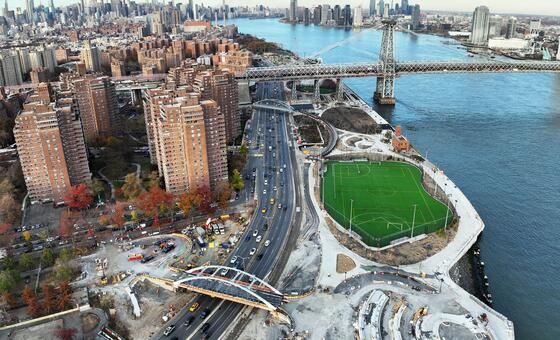
Provpnmatrix.com – Fourteen years after Hurricane Sandy transformed parts of New York City into flood zones, a major section of Manhattan’s waterfront is being rebuilt to withstand the next coastal emergency. Along the East River, construction crews are lifting East River Park by as much as 10 feet, or three metres, as part of a much larger effort to protect communities from storm surge and rising seas.
The work forms part of the East Side Coastal Resiliency project, which extends north of the Williamsburg Bridge. It is paired with a smaller project farther south, together representing an investment of roughly $2 billion. The linked protections are intended to safeguard more than 110,000 people living along this vulnerable stretch of the city.
A response shaped by Hurricane Sandy
When Sandy reached New York on 29 October 2012, its surge flooded homes, transit tunnels and subway stations. Electrical systems failed across wide areas, while fires added to the disaster. Within 48 hours, 44 people had died, almost two million residents were without electricity, and 6,500 patients had to be moved from hospitals and nursing homes.
The East River waterfront was among the areas badly affected. Bobby Issac, Assistant Commissioner of Coastal Resiliency Construction at the city’s Department of Design and Construction, recalled that flooding reached at least one storey up public housing buildings near the park. Residents were unable to enter or leave their homes.
“This whole place was inundated,” said Bobby Issac.
Sandy caused an estimated $19 billion in damage. Its impact reinforced the need for long-term coastal protection in a city whose extensive shoreline places homes, transit, public services and commercial areas near the water.
A park designed as infrastructure
At the construction site, a crane transfers fill from barges to earth-moving equipment. The visible work is dramatic, but much of the new defence system will remain concealed beneath the park landscape.
A floodwall has been incorporated into the rebuilt park, while concrete-filled piles at the edge of the water extend around 100 feet, or 30 metres, into reclaimed ground. Construction beneath the surface can be especially demanding because the land may contain traces of former piers and even ship remains.
“What you see on the top is only a third of what is built,” Mr. Issac said.
The intention is to preserve the everyday character of the public space while providing protection when severe weather arrives. In the raised portion of East River Park, no emergency movement of equipment will be required before a storm. Other areas of the waterfront will rely on 18 floodgates that can swing or slide into position. Nearly 100 flip-up barriers will operate farther south.
The design also allows for approximately 30 inches, or 76 centimetres, of sea-level rise. About 90 per cent of the system is already installed. Until construction is completed in 2027, temporary barriers can be deployed within several days to close remaining openings.
The challenge goes beyond rare superstorms
New York’s risk is not confined to another event on the scale of Sandy. Higher sea levels can turn ordinary tides into damaging floods, disrupting daily routines long before a major hurricane reaches the coast. With 520 miles, or 840 kilometres, of coastline, the city faces an unusually broad exposure to changing coastal conditions.
Kathryn Prybylski, New York City’s Assistant Commissioner of the Bureau of Coastal Resilience, will oversee operation of the new walls and gates. She said the projects now under construction grew out of Sandy, but future planning must account for a changing climate.
“These projects that are in construction now around the city are kind of a reaction to Sandy,” she said. “It’s really time for us now to look to the future.”
Regular tidal flooding could become a growing concern in coming decades without protective action. In some locations, that might mean flooding once or twice a month, or as often as 10 times monthly. Eventually, streets could be inundated with each day’s tide, altering school journeys, commutes and access to essential services.
The World Meteorological Organization has noted that the pace of global sea-level rise has almost doubled since satellite monitoring began in 1993. At the same time, warmer oceans can intensify tropical storms, increasing the dangers faced by coastal cities.
A global example with unequal stakes
Coastal risk is a worldwide concern. Nearly 770 million people—close to 10 per cent of the global population—live in coastal areas less than five metres, or 16.4 feet, above high tide. These communities are highly exposed to rising water levels and flooding.
UN Secretary-General António Guterres has warned that major cities across every continent will experience serious effects from sea-level rise, including New York. Navid Hanif of the UN Department of Economic and Social Affairs described New York’s flood-defence programme as an important example for other large cities.
“[New York’s flood defence project] is a commendable step forward. It’s also a message to all big cities,” Navid Hanif said.
“What New York is doing should be acknowledged, appreciated and emulated in other parts of the world,” he said.
Yet the consequences are not evenly shared. Rising water threatens expensive infrastructure in wealthier cities such as New York, Miami and Guangzhou in China, but for low-lying cities in South Asia—including Kolkata, Mumbai and Dhaka—the danger can be existential. More than 14 million people in South Asia face the possibility of losing homes to permanent inundation.
New York’s elevated park illustrates how climate adaptation can be woven into public space, engineering and urban life. Its floodwalls, gates and reinforced shoreline are intended to make a waterfront neighbourhood more resilient while keeping the park available for the people who use it every day. The project cannot stop seas from rising, but it offers a practical attempt to buy protection, time and choices for a city living beside the water.
Related Reading
Frequently Asked Questions
What is Higher Ground?
Higher Ground is the main topic of this guide. The article explains the context, practical details, and next steps readers should understand.
Why does Higher Ground matter?
Higher Ground matters because readers are looking for a useful answer, not just a short summary. Good content should match search intent and help them decide what to do next.