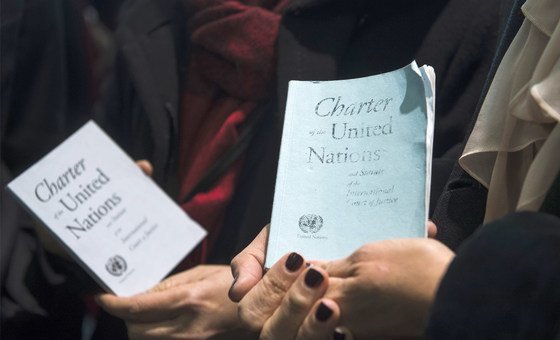
Guterres Urges Renewed Commitment to Multilateralism on UN Charter Day
Guterres urges renewed commitment to multilateralism – On the occasion of the United Nations Charter’s 81st anniversary, Secretary-General António Guterres and General Assembly President Annalena Baerbock emphasized the enduring importance of the Charter’s principles. Their joint address during a General Assembly session highlighted the need for stronger global cooperation, framing the event as a pivotal moment to reaffirm the UN’s foundational mission.
The UN Charter, signed on 26 June 1945, serves as the organization’s foundational text. It codified key tenets of international relations, including the pursuit of peace, the protection of human rights, and the fostering of collaboration among nations. These principles remain central to the UN’s identity, even as the world grapples with complex geopolitical and humanitarian challenges.
A Call for Global Unity
Speaking at the meeting, Mr. Guterres described the Charter as a profound promise to humanity. “It represents a commitment to choosing cooperation over chaos, law over lawlessness, dignity over domination, and hope over fear,” he stated. This vision, he argued, is more critical than ever in an era marked by rising tensions and fragmented alliances.
“The Charter was a promise to the world: That humanity can choose cooperation over chaos; law over lawlessness; dignity over domination; and hope over fear,” Mr. Guterres said.
Ms. Baerbock echoed this sentiment, underscoring the Charter’s role in uniting nations under a shared framework. She noted that the UN’s existence is a testament to collective human effort, with 193 member states working together to uphold common values. “Even in today’s divided world, the Charter reminds us that unity is achievable,” she remarked.
Challenges to the UN’s Mission
The commemoration took place amid growing scrutiny of the UN’s effectiveness in addressing global crises. Critics argue that the organization struggles to prevent conflicts and respond swiftly to humanitarian emergencies. Guterres and Baerbock countered that these challenges underscore the necessity of multilateralism rather than its abandonment.
Guterres highlighted specific examples of the strain on the UN’s founding ideals. He pointed to ongoing wars of territorial expansion, the targeting of civilian populations, and the erosion of ceasefire agreements as evidence of the world’s reliance on international cooperation. “The Charter’s principles are being tested,” he noted, “but they remain our best hope for a more just and stable future.”
Baerbock also acknowledged the UN’s limitations, citing its inability to avert conflicts in regions such as Sudan, Ukraine, Gaza, and Lebanon. Yet, she stressed that these shortcomings should not overshadow the organization’s successes. “The UN80 reform initiative offers a chance to enhance its efficiency and adaptability,” she explained, “ensuring it can meet the demands of the 21st century.”
UN’s Legacy of Achievement
Despite the criticisms, Guterres praised the UN’s track record in numerous domains. He highlighted peacekeeping operations that have stabilized conflict zones, humanitarian efforts that have saved millions of lives, and international justice mechanisms that have held perpetrators accountable. “The United Nations has never been perfect,” he said, “but it is irreplaceable.”
Baerbock expanded on this, emphasizing milestones such as UNICEF’s immunization campaigns. These initiatives, she noted, have prevented over 150 million child deaths since their inception. She also lauded decades of peacekeeping missions, which have protected civilians and facilitated dialogue in war-torn regions. “Access to education and healthcare has expanded globally because of the UN’s work,” she added.
“Multilateralism has not failed,” Ms. Baerbock said. “Multilateralism works every day when humanitarian workers are delivering food even before sunrise in a crisis. Multilateralism works every day even if the Security Council is blocked, when peacekeepers protect civilians.”
The Path Forward: Reform and Resilience
Both leaders called for reform, but they stressed that any changes should strengthen, not weaken, the UN’s structure. Guterres warned against a “selective application” of the Charter’s principles, arguing that sovereignty, international law, and human rights must be upheld consistently. “The Charter is not an à la carte menu,” he emphasized, “it is a blueprint for global unity.”
Ms. Baerbock further outlined the need for a more agile UN, suggesting that modernization should focus on streamlining decision-making processes and enhancing responsiveness. She also praised the organization’s role in fostering social progress, from poverty reduction programs to climate action initiatives. “The UN’s ability to adapt ensures its relevance in an ever-changing world,” she said.
The anniversary event served as a reminder of the Charter’s enduring relevance. Guterres and Baerbock framed it as a moment to defend the UN’s core values while embracing necessary evolution. They argued that global challenges—whether economic, environmental, or political—cannot be tackled by individual nations alone. “The world is interconnected,” Guterres stated, “and only through collective action can we achieve lasting solutions.”
Strengthening Multilateralism
As the UN faces mounting pressure to demonstrate its impact, the leaders urged member states to prioritize multilateral cooperation. Guterres called for renewed dedication to the principles of the Charter, emphasizing that they are not merely historical artifacts but living frameworks for international governance. “The UN’s role as a guardian of peace and justice must be reinforced,” he asserted.
Baerbock’s speech reinforced this message, celebrating the organization’s humanitarian contributions. She pointed to the UN’s efforts in providing aid to displaced populations, mediating disputes between nations, and promoting sustainable development. “These achievements prove that multilateralism works,” she said, “even when progress is slow and obstacles are significant.”
Together, Guterres and Baerbock painted a picture of a UN that, while imperfect, is essential for addressing the complexities of modern society. They argued that the Charter’s 81st anniversary should not be a time for reflection alone, but for action. “This day calls on us to renew our commitment to the ideals that bind us,” Guterres concluded. “Only by working together can we ensure a better future for all.”