From the Streets to the Global Stage: Youth Champions Deliver a Powerful Message
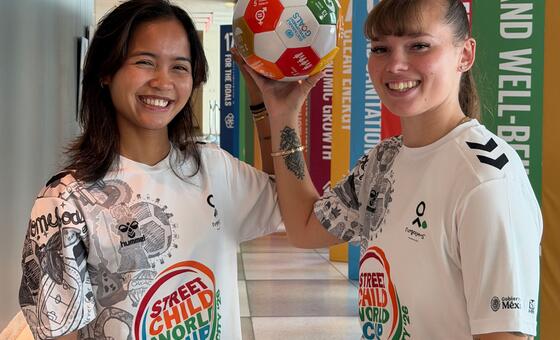
Provpnmatrix.com – Last week, two remarkable young women stepped through the doors of the Hall of Flags at United Nations Headquarters, carrying something far more significant than documents. Samantha Richards and Angela Hifume brought with them the collective hopes and aspirations of hundreds of street-connected children worldwide—youths who had long believed their voices would never be heard by those in power.
Both women are graduates of Street Child United, an organization dedicated to empowering children living on or near the streets through sport and education. Together, they presented the United Declaration of the Street Child World Cup 2026, a transformative document that weaves together the universal language of football with the empowering campaign message: “I Am Somebody.”
A Personal Journey of Transformation
For Ms. Richards, football was more than a game—it was a lifeline. Growing up, she faced considerable challenges within her home environment that severely impacted her mental wellbeing and occasionally placed her in precarious situations. The sport provided her with something essential: a sense of belonging and purpose.
“Growing up, I had some difficulties at home,” she reflected. “But football gave me friendships, leadership skills, and an outlet to speak up.”
Through her involvement with Street Child United, Ms. Richards connected with fellow athletes who were simultaneously pursuing athletic excellence and academic achievement. Inspired by their example, she followed in their footsteps and became the first member of her family to complete a college degree. Her experience has since become a platform for advocacy.
“Sport is a catalyst for mental health advocacy, and it’s ok to speak up when you’re struggling, just like I did,” she explained.
From Philippine Foster Care to Oxford
Ms. Hifume’s path to New York began thousands of miles away in the Philippine foster care system. There, she experienced the profound isolation that often accompanies being placed in care—a loneliness that sometimes made her feel as though she was nothing more than a statistic.
“In foster care, it’s so easy to think that you’re nothing more than a foster kid,” she observed.
Street Child United offered her an alternative narrative. Through the organization, she discovered a team to lead, a platform from which to speak, and eventually, opportunities that would take her across the globe. A scholarship enabled her to pursue studies in the United States, and her academic excellence earned her a PhD offer from Oxford University. Football, she noted, opened doors she never knew existed.
“Football gave me the gift of curiosity about the rest of the world beyond the game,” she said.
A Declaration Forged in Mexico
The declaration itself was not crafted in the polished corridors of international diplomacy, but rather in Oaxtepec, Mexico, where twenty-eight teams gathered for this year’s Street Child World Cup. Delegates from each participating team worked collaboratively to draft and endorse the final text, distilling their collective demands into five essential priorities.
These priorities include securing legal identity for every child, ensuring access to quality education, providing protection from violence, advancing gender equality, and guaranteeing that street-connected children have a genuine voice in decisions that directly impact their lives.
Street Child United operates as part of the UN’s Football for the Goals initiative, a program that leverages the universal appeal of sport to advance the Sustainable Development Goals. Bringing the declaration to New York—where the World Cup final was co-hosted—provided this grassroots movement with unprecedented access to a global platform.
Looking Beyond the Applause
For Ms. Richards, standing in the Hall of Flags and addressing the General Assembly represented the culmination of a personal journey. She emphasized that her presence was never solely about individual achievement.
“Standing in the Hall of Flags and the General Assembly wasn’t just about me,” she said. “It was about every young person who’s ever been made to feel invisible. Through football, I found my voice, and today we showed that our voices belong in these spaces.”
Ms. Hifume framed the declaration as a call for sustained investment rather than temporary attention. She stressed that the document represents a commitment to recognizing the inherent value of every street-connected child.
“This Declaration is about making sure every street-connected child knows they matter,” she stated. “When we invest in children, they become leaders.”
Both young leaders agree that the true challenge lies ahead. They urge governments and international agencies to treat the five demands not as ceremonial souvenirs, but as actionable priorities. As Ms. Richards concluded, the declaration rests on a fundamental truth that transcends borders and backgrounds: “we are all somebody.”
Related Reading
Frequently Asked Questions
What is I am somebody?
I am somebody is the main topic of this guide. The article explains the context, practical details, and next steps readers should understand.
Why does I am somebody matter?
I am somebody matters because readers are looking for a useful answer, not just a short summary. Good content should match search intent and help them decide what to do next.