Climate Debate Exposes Deep Divisions Over the Pace of Energy Transition
Provpnmatrix.com – World leaders gathering in New York for this year’s High-level Week General Debate confronted a central question for global climate policy: should governments rapidly end reliance on fossil fuels, or follow a slower path designed to protect energy supplies, jobs and economic development?
The debate revealed no single vision of effective climate action. For some countries, particularly vulnerable island nations, accelerating the transition is a matter of survival. Others argued that oil, gas and other conventional fuels will remain necessary while nations build reliable, affordable alternatives. A third group emphasized the commercial promise of renewable power, presenting cleaner energy as a route to greater independence, investment and employment.
The differences go beyond rhetoric. They concern the timing of energy-system changes, the future role of fossil fuels, and responsibility for funding both climate adaptation and the losses already linked to a warming planet.
UN chief urges clear plans beyond fossil fuels
UN Secretary-General António Guterres made climate action a major focus of the week, arguing that governments should move from broad commitments to concrete national plans. He called for transition strategies with defined deadlines and safeguards for workers and communities affected by changes in the energy economy.
“A future beyond fossil fuels is in sight. The question is how?”
That challenge captures the tension at the heart of the negotiations. Governments broadly recognize the scale of the climate threat, but they disagree sharply about what a fair and workable response requires in practice.
Pacific nations press for urgency
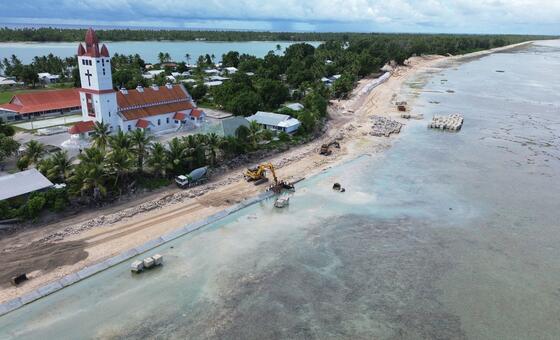
Low-lying Pacific Island States delivered some of the strongest appeals for faster action. Rising seas and increasingly severe flooding threaten communities, infrastructure and territory in countries whose emissions are small compared with those of major industrialized economies.
The President of the Marshall Islands pointed to the growing prospect that the world could exceed the Paris Agreement objective of limiting warming to 1.5°C above pre-industrial levels. That target was established by global leaders 10 years ago, and she argued that the danger of missing it leaves little room for delay.
“A much accelerated transition away from fossil fuels is the only logical response. Continued investment in fossil fuels is not only immoral but irrational,” she said.
Tuvalu made a comparable appeal, urging a transition that is fast, fair, just and orderly. Its position also included stronger measures to curb methane as well as carbon dioxide, reflecting the importance of addressing multiple greenhouse gases while energy systems change.
For vulnerable states, the argument is not simply about long-term environmental policy. It concerns whether international action is moving quickly enough to reduce risks already visible through higher seas, flooding and other climate-related pressures.
Energy security and development remain central concerns
Other governments warned against approaches that could undermine access to affordable power or restrict development opportunities. Saudi Arabia maintained that climate protection, economic progress and energy security can be pursued together. It called for transition plans that are realistic and comprehensive, while arguing against excluding any energy source.
Nigeria also rejected the idea that development and climate action must compete. Its Energy Transition Plan sets a net-zero target for 2060 and combines renewable power and clean cooking initiatives with the use of gas as a transitional fuel.
“We reject the false choice between development and climate action,” the Vice President said.
The Nigerian position illustrates why transition debates can look very different in countries still expanding electricity access and essential services. The practical challenge is to cut emissions while ensuring that households, businesses and public institutions can obtain dependable energy.
Venezuela likewise supported decarbonisation but cautioned that a transition imposed without regard to national circumstances could endanger employment, food security, production and affordable energy. Its President said the country would continue assessing new oil opportunities, including reserves in the Equatorial Margin, while also advancing its decarbonisation roadmap.
“We have achieved self-sufficiency in oil and will continue to explore the potential of new reserves, such as those in the Equatorial Margin. But we will not abandon the environmental agenda,” its President said.
Renewables presented as an economic opening
Several leaders framed climate action less as a burden than as an economic opportunity. The United Kingdom linked wind and solar investment to employment, growth and reindustrialisation, suggesting that clean-energy industries can help reshape national economies.
Lesotho announced a Just Energy Transition Fund aimed at expanding renewable-energy capacity and supporting energy independence. The initiative is also intended to help create an economy that can benefit from renewable-energy exports, with potential employment opportunities for young people and women.
Portugal highlighted another benefit of cleaner power: reducing exposure to risky external energy dependencies. More than 70 per cent of the country’s energy production comes from renewable sources, it said, and Portugal has moved its carbon-neutrality goal forward to 2045.
These approaches focus on the potential gains of transition: domestic power production, skilled work, new industries and greater resilience against disruptions in imported energy supplies. Yet realizing those benefits depends on sustained investment, planning and policies that ensure gains are shared across society.
United States takes a contrasting approach
The United States adopted a markedly different tone from many other speakers. President Donald Trump advocated expanding fossil fuel output and ridiculed earlier warnings over global warming.
“People who said we’ll all be dead in 12 years because of global warming, a name since reborn to climate change because the planet was cooling, not warming, and nobody was dead.”
He also said his administration had stopped what he described as an international “global carbon tax” on shipping proposed through Member States of the International Maritime Organization.
The opposing positions voiced during the debate show that climate action is now inseparable from wider questions of fairness, sovereignty and economic security. The broad direction of global policy may be toward lower-emission energy, but agreement over the speed, financing and consequences of that shift remains far from settled.
Related Reading
Frequently Asked Questions
What is Security sacrifice or opportunity?
Security sacrifice or opportunity is the main topic of this guide. The article explains the context, practical details, and next steps readers should understand.
Why does Security sacrifice or opportunity matter?
Security sacrifice or opportunity matters because readers are looking for a useful answer, not just a short summary. Good content should match search intent and help them decide what to do next.