Ebola in DR Congo Accelerates Beyond Containment as Funding Runs Dry
Provpnmatrix.com – The Ebola epidemic gripping the eastern Democratic Republic of Congo has entered a phase of exponential growth, according to UN field coordinators briefing journalists from the outbreak’s epicentre in Bunia, Ituri province. What began as a localized cluster of cases in mid-May has now swollen into the deadliest Ebola epidemic the country has ever recorded, with the virus advancing faster than the medical and humanitarian machinery designed to stop it.
As of the latest figures released by Congolese health authorities on Friday, 5,290 people have been confirmed infected since the outbreak was formally declared on 15 May. Of those, 2,516 have died, yielding a fatality rate of 47.6 per cent. Roughly 1,152 patients have recovered, while close to 840 remain in isolation wards or hospital beds. Contact-tracing follow-up stands at 82.9 per cent — a figure that, in a densely populated and poorly connected region, signals how many potential transmission chains remain unmonitored.
A Funding Cliff Within Weeks
Julien Harneis, the UN Senior Ebola Coordinator, delivered a stark warning to reporters: the financial runway for lifesaving intervention is measured in days, not months. Existing allocations cover only the coming weeks, after which operations face a sudden stop unless new money arrives.
“We’re only covered for the next weeks, and very soon funding will run out. Every delay in funding and implementation makes this epidemic more deadly, more difficult to stop and more expensive. So, we need that international support immediately.”
The appeal lands against a backdrop of shrinking global aid budgets. Harneis noted that cuts to humanitarian programming over the past two years have eroded the operational capacity of international relief organizations by more than 30 per cent, thinning the very workforce needed to run ring-fencing, safe-burial, and treatment operations at scale.
Exponential Spread in a Resource-Rich, Conflict-Scarred Region
The virus is now moving through six eastern provinces — Ituri, North Kivu, South Kivu, Haut-Uélé, Tshopo, and Bas-Uélé — an area Harneis described as larger than France. Half of all recorded deaths occurred within just the final 20 days of the outbreak, a statistical signature of exponential rather than linear growth. The epidemic, he stressed, is expanding both faster and wider than the response apparatus can track.
The geography compounds the problem. Decades of armed conflict in this mineral-wealthy belt have left infrastructure in ruins: roads are rutted and seasonal, government-run clinics are sparse or non-functional, and coordinated public-health services are largely absent. Harneis recounted a recent attempt to reach an Ebola hotspot in which a 60-kilometre (37-mile) drive consumed three hours, illustrating how terrain and road conditions stretch every supply line to its limit.
Financial logistics present another bottleneck. The banking system in the affected provinces, he explained, barely functions. Without functional branches or reliable electronic transfers, coordinators cannot move the cash needed to pay frontline staff on schedule, breeding resentment and slowing deployment.
Frontline Workers Pay a Heavy Toll
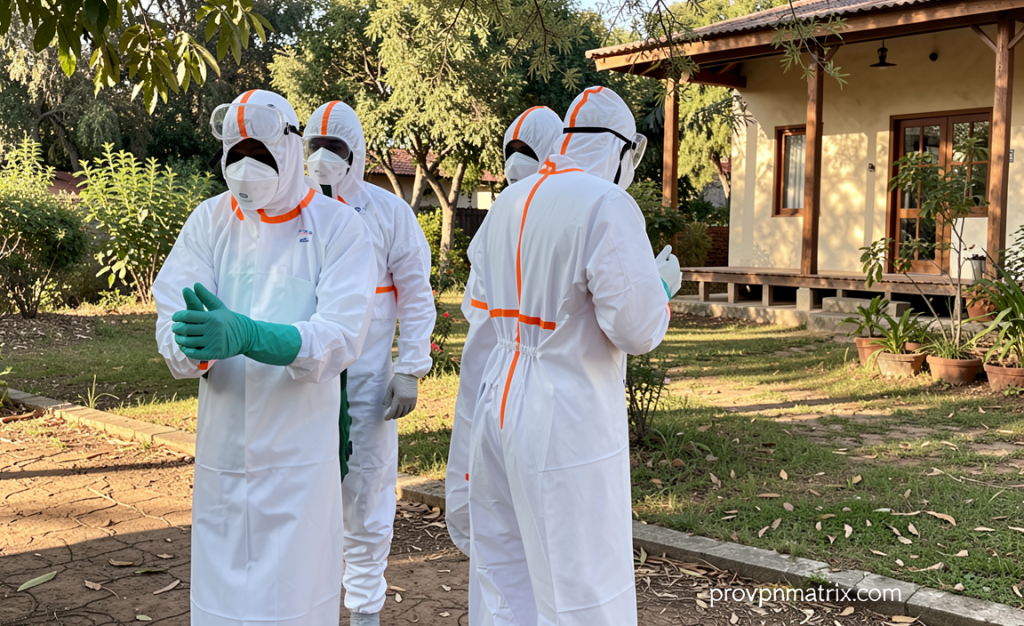
Three months into the epidemic, 160 healthcare workers have contracted Ebola; 43 of them have died. Beyond the virus itself, responders face a hostile environment. Harneis described incidents in which ambulances were burned and stoned, healthcare facilities were attacked, and frontline staff were assaulted by local youths — conditions he labelled “brutal.”
“And then when we do respond, apart from the threat from the virus, healthcare workers and frontline workers have been attacked by youths, ambulances have been burned and stoned and the healthcare facilities have been attacked.”
Such violence, rooted in community fear and frustration over perceived neglect, creates a vicious cycle: workers hesitate to enter hotspots, response times lengthen, and transmission windows widen.
International Response and the Limits of Current Capacity
Despite the operational headwinds, a constellation of specialist agencies continues working alongside Congolese authorities. The World Health Organization leads clinical and epidemiological coordination; the World Food Programme sustains nutrition and logistics; UNICEF supports water, sanitation, and community communication; the International Organization for Migration (IOM) manages displacement and cross-border flows; and partners such as Médecins Sans Frontières provide direct clinical care in hard-to-reach settings.
The United States has contributed $80 million to the DRC government to expand hospital bed capacity and strengthen safe-burial practices, among other interventions. Yet that infusion, significant as it is, has not offset the cumulative effect of broader aid reductions that have hollowed out institutional capacity over recent years.
Fear as a Public-Health Variable
Harneis closed his briefing by framing the epidemic not merely as a biomedical event but as a social one. In communities where clinics are distant, roads impassable, and trust in authorities fragile, an invisible pathogen that kills neighbours overnight generates a fear that can outpace any vaccine or treatment protocol.
“It’s a disease, it’s an invisible threat which comes into your community and suddenly people start falling sick around you and your loved ones die. And that generates a lot of fear in any community.”
For the people of eastern Congo, that fear is compounded by the knowledge that the region’s mineral wealth has long attracted outside attention while its residents received little in return. The epidemic, in that context, is both a medical emergency and a reckoning with decades of underinvestment in the most basic pillars of public life — roads, banks, clinics, and the rule of law. Until international donors close the funding gap within weeks, the exponential curve that defines this outbreak will continue to outrun every intervention deployed against it.
Related Reading
Frequently Asked Questions
What is DR Congo Ebola outbreak spreading exponentially?
DR Congo Ebola outbreak spreading exponentially is the main topic of this guide. The article explains the context, practical details, and next steps readers should understand.
Why does DR Congo Ebola outbreak spreading exponentially matter?
DR Congo Ebola outbreak spreading exponentially matters because readers are looking for a useful answer, not just a short summary. Good content should match search intent and help them decide what to do next.