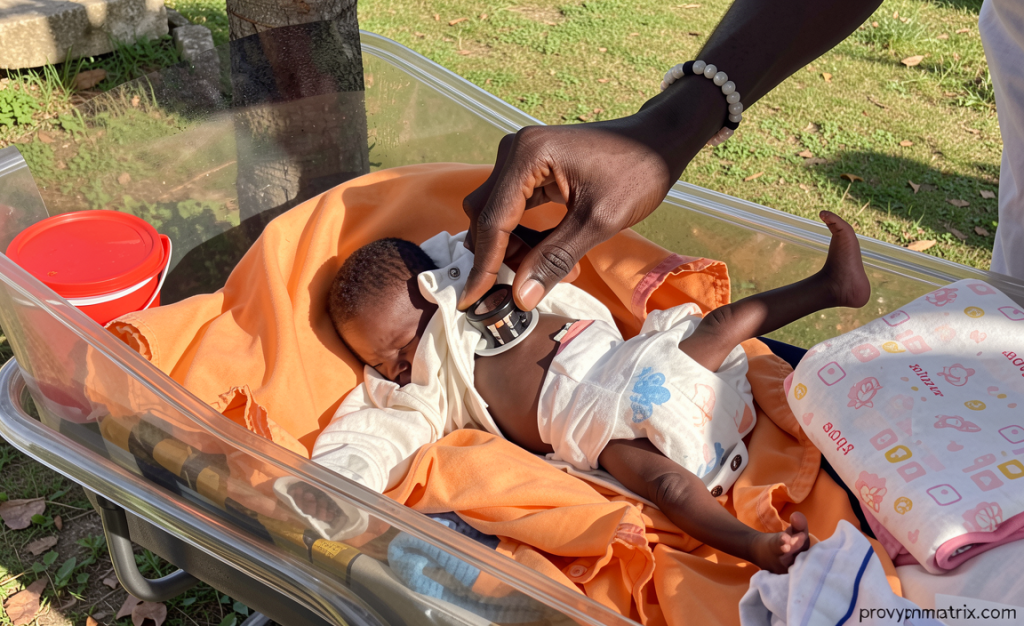
Africa Sets Course to Close a Six-Million-Worker Health Gap by 2035
Provpnmatrix.com – By the mid-2030s, the African continent is projected to lack more than six million health professionals — a deficit that would leave hundreds of millions without reliable access to basic medical care. On Wednesday, health ministers gathered in Addis Ababa, Ethiopia, to announce a sweeping decade-long strategy designed to confront that looming crisis head-on. The initiative, formally adopted during the 76th session of the World Health Organization Regional Committee for Africa, represents a fundamental rethinking of how the continent builds, deploys, and sustains its medical workforce.
The plan, titled the Health Workforce Management Programme in Africa (2026–2035), moves beyond the narrow objective of producing more graduates. Instead, it targets the architecture of entire health systems — their financing, distribution, retention mechanisms, and alignment with actual population needs. African ministers endorsed the framework as a coordinated investment agenda, insisting that a skilled, motivated, and adequately supported workforce is the non-negotiable foundation for meeting the continent’s rapidly expanding health demands.
From Training Pipelines to Systemic Transformation
The ministers approved a ten-year programme with a concrete numerical target: train, employ, and retain three million additional health workers across the continent. That figure is not merely an aspirational number; it is anchored to labour-market modelling that maps where shortages are most acute and where existing capacity sits idle.
“Our Member States have recognised that training health professionals is only the beginning,” said Dr. Mohamed Yakub Janabi, WHO regional director for Africa.
“This programme turns evidence into concrete action and political commitment into sustainable investments for Africa’s health workforce and, ultimately, for the health and well-being of our populations.”
The shift in framing is deliberate. For years, the dominant policy response to workforce gaps has been to expand medical school seats and nursing programmes. The new agenda insists that without parallel investments in employment creation, equitable geographic distribution, and long-term career sustainability, additional graduates will simply deepen the mismatch between supply and demand.
The Paradox: Empty Beds and Unemployed Graduates
Africa’s health workforce has grown meaningfully over the past decade, reaching nearly 5.72 million professionals by 2024. Yet that growth remains far short of what the continent requires. Current estimates place available capacity at roughly 46 per cent of the level needed to meet population health needs — meaning more than half the required workforce simply does not exist in functional form.
Compounding the shortage is a striking structural contradiction. While hospitals and clinics in rural and peri-urban areas struggle to fill basic posts, nearly one million trained health professionals across the continent sit unemployed. Recent graduates bear the brunt of this mismatch: in numerous countries, more than half of newly qualified nurses, physicians, and midwives cannot secure a position shortly after completing their programmes.
For the WHO, this paradox underscores that the problem is not a simple supply deficit but a failure of alignment between education pipelines, labour-market demand, job-creation capacity, and sustainable financing. The new programme therefore provides member states with a roadmap spanning workforce planning, quality training expansion, employment generation, and retention incentives targeted at the regions where need is greatest.
The Economic Case: Dollars In, Multiples Out
WHO has quantified the investment required to close the gap: an additional four to six dollars per person per year across African economies. Against that cost, the projected returns are substantial. Modelling suggests every dollar directed into health-worker capacity could generate up to ten dollars in direct economic benefits and approximately thirty times that amount in broader social returns — gains flowing through improved population health, elevated labour productivity, and strengthened national economies.
The framing positions workforce investment not as a budgetary burden but as high-yield infrastructure spending, comparable in logic to investment in roads or power grids. For finance ministers and development partners watching the Addis Ababa deliberations, the message is that underfunding the health workforce carries a measurable macroeconomic cost that dwarfs the cost of closing the gap.
A Parallel Commitment: Every Child’s Best Start
Alongside the workforce programme, the ministers endorsed a new regional strategy aimed at giving every child in Africa the strongest possible foundation in early life. The strategy calls for coordinated action spanning health, nutrition, social protection, water and sanitation, education, finance, and additional sectors — an explicit acknowledgment that no single ministry or agency can meet children’s needs in isolation.
At the centre of that strategy sits a commitment to supporting parents, caregivers, and communities, whom WHO identifies as playing the most critical role in helping children survive, grow, learn, and thrive. The approach treats household-level capacity-building as the primary intervention, with state systems providing the enabling environment rather than attempting to substitute for family and community structures.
What Comes Next
Deliberations at the Addis Ababa session continue through 28 August, with decisions expected to shape the region’s health agenda for the coming year and beyond. The outcomes will determine how quickly the three-million-worker target translates into funded national action plans, how retention incentives are calibrated to rural and frontier postings, and whether the children’s strategy moves from ministerial endorsement to operational budgets within the next fiscal cycle.
For a continent whose population is projected to double within two decades, the window for building adequate health infrastructure is narrowing. The Addis Ababa announcements signal that African governments, backed by WHO technical support, intend to close that window on their own terms — with coordinated investment, equitable distribution, and a workforce that stays where it is needed most.
Related Reading
Frequently Asked Questions
What is More health workers stronger systems?
More health workers stronger systems is the main topic of this guide. The article explains the context, practical details, and next steps readers should understand.
Why does More health workers stronger systems matter?
More health workers stronger systems matters because readers are looking for a useful answer, not just a short summary. Good content should match search intent and help them decide what to do next.