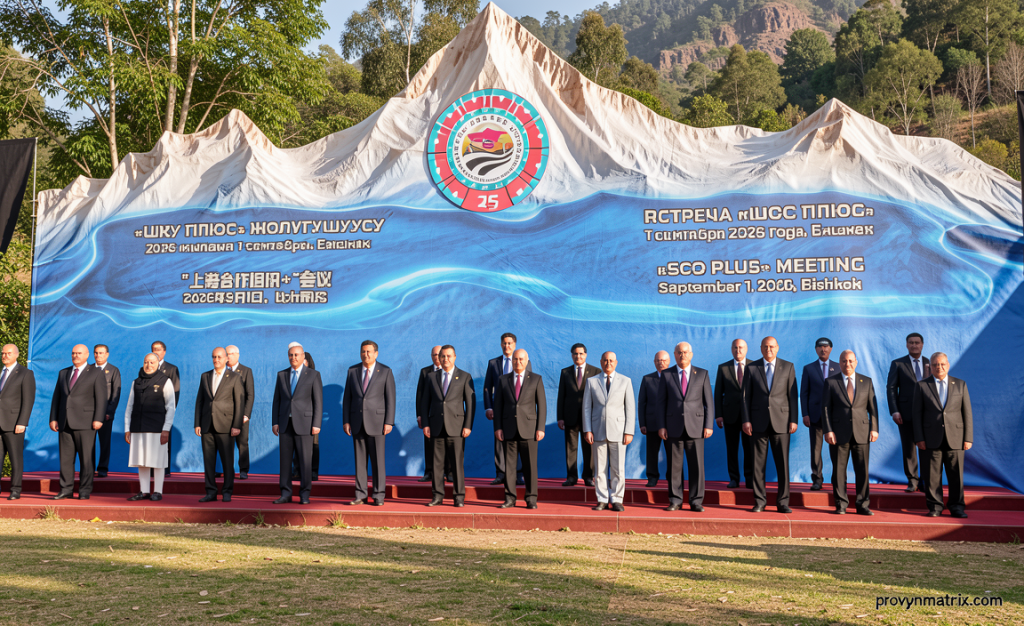
Guterres Seizes SCO Summit Stage in Bishkek to Push for a Multipolar Reset of Global Institutions
Provpnmatrix.com – The Shanghai Cooperation Organization’s latest summit, convened in Bishkek, Kyrgyzstan, gave UN Secretary-General António Guterres a high-profile platform to press what he frames as an urgent structural question: whether the world’s governing architecture can be bent toward greater inclusivity before the gap between power realities and institutional design widens beyond repair. Speaking to heads of state from the SCO’s ten member nations — a bloc spanning China, India, Pakistan, Russia, and several Central Asian republics — Guterres argued that the ongoing redistribution of global influence is not a threat to be managed but a corrective to be embraced.
Multipolarity as a Corrective, Not a Disruption
Guterres framed the shift away from unipolar dominance in explicitly positive terms, telling the assembled leaders that a more distributed balance of power, handled well, would reinforce rather than weaken the multilateral system. He positioned multipolarity as both a moral precondition and a practical engine for fairer international relations.
“Our world is increasingly multipolar. That is a good thing and must be strengthened.”
He went further, labeling multipolarity “a condition for justice in global governance and international relations” and “the best support for effective multilateralism.” The rhetorical framing matters: by coupling multipolarity to multilateralism rather than treating them as competing logics, Guterres sought to reassure smaller states that a more diffuse power landscape would not simply replace one hegemon with several competing ones, but would instead deepen the institutional scaffolding through which collective decisions are made.
The argument rests on a diagnosis he laid out plainly: although the distribution of economic and military weight has moved dramatically since the post-war settlement, the principal international bodies still encode the geopolitical map of 1945. The United Nations Security Council, the Bretton Woods institutions, and related fora, in his telling, remain calibrated to a world that no longer exists.
“We must reform our multilateral institutions, including the United Nations and the Bretton Woods system, to reflect today’s realities, and increase the representation and influence of developing countries to build a just world order.”
Regional Flashpoints: From Hormuz to Kyiv
Before turning to institutional design, Guterres addressed the conflicts consuming the current diplomatic calendar. On the Middle East, he voiced alarm that ceasefires and negotiated arrangements are being broken with increasing frequency, and he called for maximum restraint alongside strict adherence to international law. He stressed the necessity of what he termed “a peaceful, just and durable settlement” capable of restoring regional stability while protecting navigational freedoms through chokepoints such as the Straits of Hormuz and Bab al-Mandab — corridors through which roughly a fifth of global oil trade transits.
On Gaza, the Secretary-General insisted the ceasefire “must be respected” and pressed for full execution of the Comprehensive Plan to End the Gaza Conflict. He demanded that logistical obstacles blocking humanitarian convoys be dismantled and renewed his call to halt settler violence and settlement expansion in the occupied West Bank.
“There will only be peace with a two-State solution.”
He described the end-state as two independent, sovereign, democratic states — Israel and Palestine — coexisting in security, with Jerusalem/Al Quds serving as capital of both.
On Ukraine, after more than four years of full-scale war, Guterres declared that “it is high time for a full and immediate ceasefire,” adding that such a step would clear the path toward negotiations aimed at “a just, lasting and comprehensive peace in line with international law.”
Debt, Climate, and the Economics of Transition
Guterres linked institutional reform to the fiscal architecture that governs developing economies. He argued that unsustainable debt loads continue to strangle growth prospects across the Global South and called for a restructuring of global financial architecture to inject what he called “justice and equity.” Multilateral development banks, in his formulation, must become “bigger, better and bolder” in financing national development programmes.
On climate, he warned that current trajectories place the world on course to overshoot the 1.5 °C threshold established under the Paris Agreement. He called for accelerated emissions reductions and a faster pivot toward renewable energy, while insisting that climate action is inseparable from climate justice — meaning substantially larger financial flows to developing nations bearing disproportionate costs of mitigation and adaptation.
He also flagged the governance of critical minerals — lithium, cobalt, rare earths, and other inputs essential to batteries, electronics, and clean-energy hardware — urging that producing countries capture a fairer share of the value chain rather than exporting raw inputs at depressed prices.
Artificial Intelligence and Inclusive Governance
In a brief but pointed passage, Guterres stated that artificial intelligence must serve all countries, not a narrow technocratic elite. He stressed that achieving this will require effective guardrails and more inclusive governance mechanisms, implicitly calling for multilateral norms rather than unilateral platform rules.
The SCO as a Multilateral Pillar
Guterres praised the longstanding partnership between the United Nations and the SCO, describing the organization — founded in 2001 and now encompassing ten member states across Eurasia — as “an important pillar of multilateralism.” He outlined four areas where UN-SCO cooperation could be deepened, though the specific pillars were detailed in a separate briefing. The SCO’s scale, both in population covered and geographic span, makes it one of the largest regional groupings on the planet, and its growing economic weight gives it leverage in shaping norms on trade, connectivity, and security that extend well beyond its borders.
On the margins of the summit, the Secretary-General also held a bilateral meeting with Iranian President Masoud Pezeshkian, a contact that underscored the SCO’s role as a venue where states otherwise at odds can maintain diplomatic channels.
The Bishkek address lands at a moment when the post-1945 institutional order faces its most sustained challenge since the Cold War’s end. Whether the SCO’s member states — whose own interests diverge sharply on Ukraine, South Asia, and energy markets — will translate Guterres’ institutional rhetoric into concrete reform proposals remains the central question the summit leaves unresolved.
Related Reading
Frequently Asked Questions
What is At SCO summit In Kyrgyzstan Guterres?
At SCO summit In Kyrgyzstan Guterres is the main topic of this guide. The article explains the context, practical details, and next steps readers should understand.
Why does At SCO summit In Kyrgyzstan Guterres matter?
At SCO summit In Kyrgyzstan Guterres matters because readers are looking for a useful answer, not just a short summary. Good content should match search intent and help them decide what to do next.