The Tides Are Turning Against Us: A Decade of Accelerating Sea-Level Rise and Its Human Cost
Provpnmatrix.com – In 2024, global ocean levels climbed by a record 5.9 millimetres in a single year — a sharp acceleration from the already alarming 4.7 mm annual average recorded between 2014 and 2023. The pace of change now outstrips anything captured in the instrumental record, and the consequences are no longer confined to distant projections. Coastal communities across every continent are confronting flooded streets, eroded shorelines, and infrastructure failures that were once considered decades away.
The drivers are well understood. Human-induced warming of the atmosphere is transferring heat into the ocean at an unprecedented rate. Roughly 91 per cent of the planet’s excess thermal energy is absorbed by seawater, causing it to expand volumetrically. Simultaneously, melting ice sheets and glaciers add fresh water to the system. Together, these mechanisms lock in future rises regardless of near-term policy choices, though the ultimate magnitude still depends on how aggressively emissions are curtailed.
Projections: From Half a Metre to Nearly Two
Even under the most optimistic emissions pathway modelled by scientists, ocean levels are expected to climb by up to 0.55 metres by the year 2100. Under worst-case trajectories, the figure exceeds one metre. A smaller but non-negligible probability exists, under high-emission scenarios, of a jump approaching two metres before the century closes. For low-lying nations, the difference between these outcomes is not an academic distinction — it is the difference between managed retreat and existential displacement.
Who Bears the Burden
Approximately 770 million people — roughly one in every ten on Earth — reside within five metres of the high-tide line. Their proximity to the water’s edge is already producing measurable harm:
Flooding events are degrading hospitals, schools, and sanitation networks in coastal zones. Contamination of drinking-water supplies elevates the risk of waterborne illness, while the chronic uncertainty of living beside an encroaching shoreline compounds psychological stress. Fisheries and tourism, which anchor the economies of countless coastal regions, face growing disruption as habitats shift and access points erode.
Some projections indicate that as many as 1.2 billion people worldwide could be displaced by 2050, seeking not merely safer ground but also the possibility of rebuilding a livelihood. Newer modelling suggests that sea-level vulnerability in certain regions has been materially underestimated, implying that tens of millions more residents may face greater exposure than previously acknowledged.
Beyond the physical infrastructure, the losses extend into cultural heritage, ancestral territories, and traditional ways of life — dimensions of human experience that carry a profound psychological toll difficult to quantify in dollar terms.
Geographic Flashpoints
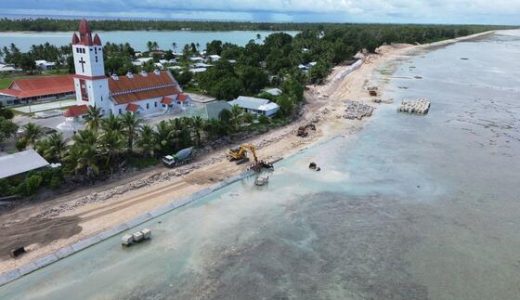
The risk is distributed unevenly. Small Pacific island nations confront relative sea-level rise running at more than twice the global average, leaving them acutely exposed to increasingly frequent inundation events. Low-lying delta cities such as Dhaka, Mumbai, and Kolkata place over 14 million residents at risk of losing homes, livelihoods, and lives. Coastal megacities including Miami, New York, and Guangzhou face potential infrastructure losses measured in trillions of dollars if protective systems fail.
A critical asymmetry compounds the injustice: many of the nations confronting the most immediate threats contributed least to the greenhouse-gas emissions driving the rise, and often possess the fewest fiscal and institutional resources to respond.
The Economic Stakes
Without meaningful adaptation investment, annual global losses attributable to sea-level rise could reach $1.4 trillion. Small Island Developing States already absorbed $153 billion in climate-hazard damages between 1970 and 2020. In the United States, home-insurance premiums in disaster-risk zones surged by 33 per cent between 2020 and 2023, signalling how quickly private markets are repricing coastal exposure.
Ports that facilitate more than 80 per cent of global trade are increasingly vulnerable to storm-surge flooding and chronic inundation, introducing fragility into international supply chains that few economies can afford to disrupt.
The Adaptation Gap
Developing countries require an estimated $310 to $365 billion annually to implement the adaptation measures they need. Global adaptation finance delivered in 2023 stood at roughly $26 billion — a fraction of the requirement. Closing that gap demands coordinated action on several fronts:
Early-warning systems must be deployed so that populations receive timely alerts before disaster strikes. Engineering and nature-based defences — sea walls, mangrove restoration, dune rebuilding, and where necessary the managed retreat of communities from threatened zones — require sustained funding and political will. Many regions still lack even basic monitoring of sea conditions, leaving decision-makers blind to local trends. Legal frameworks must also evolve to address questions of statehood, maritime zones, and sovereignty in the event that land is permanently submerged.
A Tipping Point in Antarctica
One feature of the cryosphere looms over all projections: the Thwaites Glacier in West Antarctica, spanning approximately 190,000 square kilometres. Its collapse alone could trigger a sudden, irreversible sea-level jump exceeding half a metre — a genuine tipping point beyond which the trajectory cannot be reversed. Monitoring this glacier and understanding its stability is therefore not merely a scientific priority but a civilisational one.
The ability to act and adapt today will prove decisive for whether rising seas become a manageable challenge or a generational crisis.
Transitioning away from fossil fuels remains the single most consequential lever available to slow the warming that drives ocean expansion. Yet mitigation alone, arriving too late, will not protect the communities already living at the water’s edge. Adaptation measures are needed now, in parallel, funded at the scale the problem demands. The choices made in the coming years will determine whether the rising tide is met with preparation or met with catastrophe.
Related Reading
Frequently Asked Questions
What is Rising seas rising stakes?
Rising seas rising stakes is the main topic of this guide. The article explains the context, practical details, and next steps readers should understand.
Why does Rising seas rising stakes matter?
Rising seas rising stakes matters because readers are looking for a useful answer, not just a short summary. Good content should match search intent and help them decide what to do next.