Guterres Pays Tribute to Indonesian Peacekeepers Killed in Lebanon
Provpnmatrix.com – United Nations Secretary-General António Guterres has honoured four Indonesian peacekeepers who died recently while serving in Lebanon, describing their loss as a profound reminder of the risks faced by personnel deployed in conflict zones.
During a visit on Monday to the Indonesia Armed Forces Peacekeeping Centre in Sentul, he placed a wreath in their memory and offered condolences to the families of the fallen troops. The Secretary-General also used the visit to make a forceful case for the continued importance of UN peacekeeping at a moment of growing global instability.
“Their service and their sacrifice will never be forgotten. No one should die serving the cause of peace,”
Guterres told the assembled personnel that the four Indonesians had given their lives while protecting others under exceptionally difficult conditions. He said attacks targeting peacekeepers represent serious breaches of international humanitarian law and, in some circumstances, could constitute war crimes.
Accountability for such attacks is essential, he said, while reaffirming his commitment to press UN Member States to protect the safety and security of all UN personnel. Peacekeepers are deployed with the consent of international institutions and host countries, but their work often places them close to armed confrontations, humanitarian emergencies and fragile political transitions.
Indonesia’s expanding role in peacekeeping
Indonesia is among the largest national contributors to UN peacekeeping operations. Nearly 2,000 Indonesian uniformed women and men are currently serving in seven missions, making the country the sixth-largest contributor worldwide.
The contribution reflects Indonesia’s longstanding involvement in international efforts intended to reduce violence, protect civilians and support political settlements. Next year, Indonesia will co-host the UN Peacekeeping Ministerial alongside the Netherlands, a meeting expected to bring governments together around the future needs of peacekeeping missions.
Guterres described the UN’s “blue helmets” as a source of hope for communities living through some of the world’s hardest crises. He also called them a personal source of pride. Across UN operations, roughly 50,000 peacekeepers work far from their home countries in environments where security can change rapidly.
Their responsibilities differ by mission, but can include helping opposing sides avoid escalation, protecting civilians, supporting the delivery of urgently needed assistance and creating safer conditions for negotiations. Their presence does not replace national political leadership, but it can provide time and space for political processes to develop.
Central African Republic deployment
Some of the troops listening in Sentul are preparing to deploy to the Central African Republic, where the UN has maintained a major peacekeeping operation. Guterres said the country had made meaningful progress but still required determined support to complete its recovery from conflict.
“A success story that still needs to be completed,”
he said of the Central African Republic, a country with which he has been involved for two decades, beginning during his time as UN High Commissioner for Refugees.
He pointed to agreements reached between many armed groups and the Government, as well as efforts by fighters to lay down their weapons. Indonesian troops joining the mission will have an important role in helping state institutions operate across the national territory, he said.
Progress in that work could eventually allow the UN to reduce the size of its mission in a gradual and responsible way. A drawdown would depend on conditions that permit national authorities to carry out their responsibilities and maintain stability without the same level of international support.
Guterres briefly struck a lighter tone as he addressed the deploying personnel, saying he believed that no “bad guys” in the Central African Republic would dare challenge Indonesians. The remark underscored his confidence in the professionalism and preparedness of the country’s peacekeeping contingent.
A call for stronger international cooperation
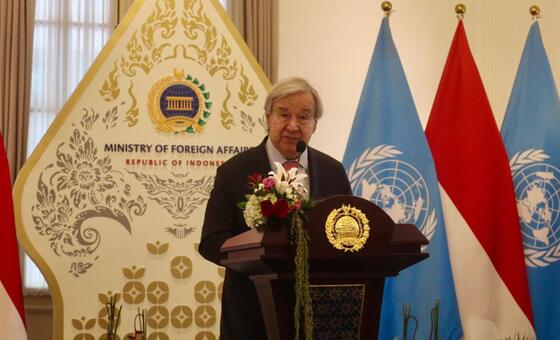
Later in Jakarta, at Indonesia’s Ministry of Foreign Affairs, the UN chief praised the country as an important supporter of multilateral cooperation and as a diplomatic connector between the Global North and Global South.
He said the international system is being tested by an accumulation of conflicts, worsening inequality and declining public trust in institutions. Those pressures have prompted many people to question whether cooperation between nations can still deliver practical results.
“The answer to deepening frustration with multilateralism is not less multilateralism. It is better multilateralism,”
Guterres said, arguing that global institutions need reform rather than abandonment. He called for international financial institutions and the UN Security Council to better reflect the realities of the contemporary world.
The appeal has particular relevance for countries such as Indonesia, whose diplomatic engagement extends across regional and global issues. In a period when crises often cross borders through displacement, food insecurity, economic disruption and armed violence, the effectiveness of international cooperation remains closely tied to the willingness of countries to work collectively.
Gaza and Myanmar concerns
Speaking alongside Foreign Minister Arrmanatha Nasir, Guterres also addressed conflicts and humanitarian pressures beyond Indonesia. On Gaza, he said the situation could not continue.
“The nightmare must end.”
He urged full implementation of the peace plan and warned against allowing the prospect of a two-State solution to disappear. He also recognised Indonesia’s consistent support for the Palestinian people.
The Secretary-General raised concern about Myanmar’s worsening crisis and repeated his appeal for protection for people escaping violence and persecution. That includes Rohingya refugees living across the region, whose safety and humanitarian needs remain central to the broader regional response.
His visit brought together two connected messages: respect for those who serve under the UN flag, and a warning that international cooperation must be strengthened if it is to meet today’s conflicts. For Indonesian peacekeepers preparing to depart, the tribute to their fallen colleagues was both a moment of mourning and a reminder of the responsibility they are about to assume.
Related Reading
Frequently Asked Questions
What is Guterres honours Indonesian troops who paid?
Guterres honours Indonesian troops who paid is the main topic of this guide. The article explains the context, practical details, and next steps readers should understand.
Why does Guterres honours Indonesian troops who paid matter?
Guterres honours Indonesian troops who paid matters because readers are looking for a useful answer, not just a short summary. Good content should match search intent and help them decide what to do next.