New York Preservation Lab Works to Rescue Fragile Sounds and Images
Provpnmatrix.com – Deep below Lincoln Center, a specialized New York Public Library team is racing to protect recordings and films that document more than a century of cultural, political and personal history. Their work involves aging reels, damaged tapes, obsolete discs and the increasingly scarce equipment needed to play them.
For media preservation engineer Rhony Dostaly, the task has a simple explanation at home.
“I tell my kids I work in a time machine.”
His job allows him to recover material created decades ago and prepare it for audiences today. In the archive, that can mean preserving a family film, an early international radio programme, a civil rights record or a documentary about a major figure in United Nations history.
The urgency is growing. Physical media continues to deteriorate, while the devices that read it are no longer being made. Knowledge of how to restore and maintain those machines is becoming harder to find as well.
Personal histories and public memory
Dostaly has encountered remarkable lives through the collections he handles. Among them are home movies made by Harry Belafonte, the American singer, actor, civil rights advocate and longtime UNICEF Goodwill Ambassador. Belafonte filmed his family for years, capturing scenes ranging from his son learning to ride a bicycle in Central Park to journeys overseas.
The footage gave Dostaly an unusually intimate view of a family changing over time.
“I’ve actually seen his kids from toddlers all the way to adults.”
Other discoveries have had a different emotional weight. Footage of Malcolm X, including scenes from his travels to Mecca, was especially meaningful to Dostaly. The prospect that these images could be made accessible to the public gave the preservation work a wider purpose.
“I’m the one who’s going to be making it available for everyone to see.”
He hopes younger viewers who encounter such records will better understand events that occurred before their own lifetimes and recognize why historical memory matters.
Inspecting film one frame at a time
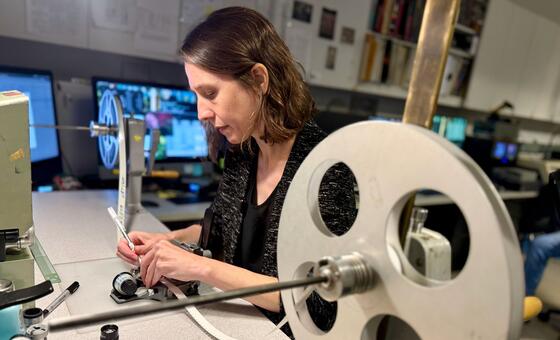
In a nearby workspace, media preservation coordinator Casey McNamara studies old film using a jeweller’s loupe, examining each section for splits, joins and shrinkage. One reel is labeled “BHARATA NATYAM,” referring to one of India’s oldest classical dance traditions.
The condition of incoming material can vary dramatically. Films may arrive in corroded containers, on worn projection reels, in fabric bags or loosely packed in plastic. Without careful inspection, repair and digitization, many of these collections could remain inaccessible for years or disappear altogether.
The lab belongs to the library’s Digital Collections Operations unit. After material is digitized, much of it can be made available to library-card holders, turning difficult-to-view objects into resources that can be studied and enjoyed without repeatedly handling the originals.
Lab manager Shahed Dowlatshahi said the mission is shaped by a widening gap between the historical value of old formats and the shrinking supply of playback technology.
“The tapes and the decks are no longer being manufactured, but the history needs to be preserved.”
This type of work is highlighted each year on 27 October through the World Day for Audiovisual Heritage, which draws attention to recordings and moving images at risk of being lost through neglect, decay or technological obsolescence.
Voices from the early United Nations
Audio preservation specialist Jeffrey Willens recently handled a 16-inch disc stored in a brown paper sleeve bearing the title A Year To Remember. The UN Radio Division created the programme for broadcast on New Year’s Day in 1949, when the Organization was still based at Lake Success on Long Island.
Copies were intended for radio broadcasters and UN offices in different parts of the world. On a turntable equipped with a microscope, the disc can once again deliver the voices of actor Fredric March and sportscaster Ted Husing.
Elsewhere in the lab, technicians are digitizing the work of William Greaves, a pioneering African American documentary filmmaker. His 2001 film Ralph Bunche: An American Odyssey explores the life of the American diplomat who received the 1950 Nobel Peace Prize for helping mediate armistice agreements between Israel and Arab States.
Bunche, the first Black recipient of a Nobel Prize, later served as UN Under-Secretary-General. Preserving films about figures such as Bunche helps ensure that future audiences can engage with records of diplomacy, civil rights and cultural change in their original audiovisual form.
A battle against chemical decay
Many preservation challenges cannot simply be fixed with a software upgrade. The acetate film in the collection can develop “vinegar syndrome,” a chemical process that makes film brittle, distorted and pungent. Cold storage may slow the deterioration, but it cannot undo it.
“Once that process starts, there’s no stopping it. You can slow it down with cold storage, but it will never reverse.”
Audiotape creates its own difficulties. It may reach the lab wrinkled, stuck together or otherwise damaged, requiring delicate manual work before a recording can safely be transferred. Media preservation engineer Victoria Fajardo compares the process to a careful medical procedure.
“To be able to repair it and then play it and get a successful transfer is kind of like surgery.”
For Fajardo, there is also a rare sense of discovery in hearing material that may not have been played since the day it was recorded.
“It really is such a privilege to be one of the first people to listen to a lot of this content for the first time since it’s been recorded.”
Even formats once viewed as dependable are showing their age. Digital Betacam cassettes have begun shedding material, forcing video specialist Francis Dougherty to clean playback decks between transfers. Dougherty, who originally built the video lab, sees the challenge intensifying with each passing year.
“Every year this job gets more difficult. Every year physical media degrades.”
The equipment itself is another endangered resource. Older machines are becoming scarce, and so are the technicians who know how to repair them.
“The machines are getting rarer. The old men who repair the machines are getting even rarer.”
When asked how quickly preservation efforts need to move, Dougherty’s response is immediate.
“It should have been dealt with 20 years ago.”
Training programmes continue to prepare younger specialists, but fewer working machines remain for them to use. The work underway in New York is therefore more than a technical exercise: it is an effort to keep irreplaceable evidence of human experience audible, visible and available before both the media and the means to recover it are gone.
Related Reading
Frequently Asked Questions
What is Inside the New York time machine?
Inside the New York time machine is the main topic of this guide. The article explains the context, practical details, and next steps readers should understand.
Why does Inside the New York time machine matter?
Inside the New York time machine matters because readers are looking for a useful answer, not just a short summary. Good content should match search intent and help them decide what to do next.