Adapting the Blue Helmets: A Landmark Review of UN Peace Operations’ Future
Provpnmatrix.com – From helping Namibia secure its independence from South African rule to overseeing the first democratic elections in Mozambique and Cambodia after decades of civil war, and from disarming thousands of child soldiers in Sierra Leone to stabilising fragile post-conflict states, United Nations peace operations have shaped the trajectory of dozens of nations over the past seven decades. Yet the missions now face an operating environment unlike anything their architects envisioned in 1948.
On Wednesday at UN Headquarters in New York, Secretary-General António Guterres delivered what he described as the first comprehensive review of the future of every form of UN peace operation. The exercise was commissioned by the landmark Pact for the Future and laid out recommendations for Member States on how the organisation’s peace toolbox can be recalibrated to meet evolving threats and shifting geopolitical realities.
“UN peace operations are indispensable tools for maintaining international peace and security, but to be more effective, they must adapt to new realities.”
A World at Its Most Fragmented
The timing of the review is pointed. The globe currently contends with the highest number of active conflicts recorded since 1945, and the death toll from armed warfare continues to climb. Peace operations, once deployed primarily to implement signed agreements, are increasingly tasked with containing violence in environments where no such agreements exist. Guterres framed the challenge plainly: the UN and its Member States must evolve in step with the missions themselves if they are to remain relevant.
The Secretary-General’s assessment spans the full spectrum of UN peace operations. At one end sit small civilian special political missions — sometimes as modest as a two-person office supporting a Personal Envoy. At the other end stand large, multidimensional peacekeeping deployments authorised by the Security Council, involving tens of thousands of uniformed personnel across multiple continents. Between those poles lie peace enforcement operations, which carry a distinct legal character.
The Three Pillars and Their Cost
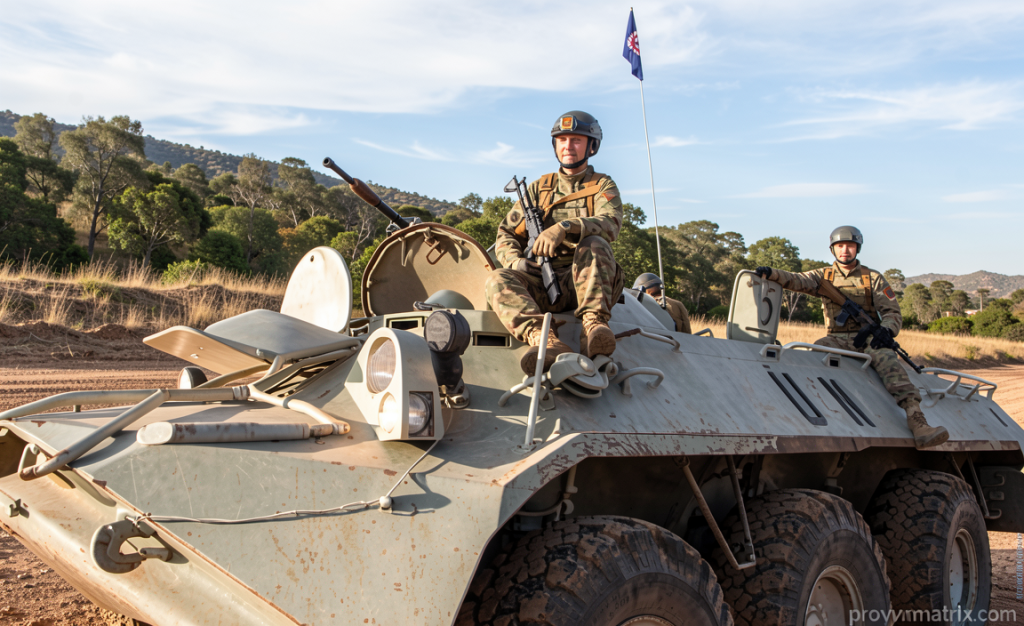
Since 1948, the Security Council has authorised UN peacekeepers to help conflict parties reach political solutions, prevent disputes from spiralling into full-scale war, and reduce armed violence while diplomatic tracks remain open. Eleven such missions are currently active. The personnel who staff them are colloquially known as “Blue Helmets” for their distinctive light-blue headgear, and their conduct is governed by three foundational principles: the consent of the parties to the conflict, impartiality, and non-use of force except in self-defence or in defence of their mandate.
The work carries a heavy human price. More than 4,500 UN peacekeepers have lost their lives on missions around the world since the programme began. Their collective contribution was recognised when the entire corps received the Nobel Peace Prize in 1988, awarded “for preventing armed clashes and creating conditions for negotiations.”
“They help defuse crises, stop conflict, sustain ceasefires and protect civilians. In lands stained by bloodshed, they create space for dialogue and open pathways to peace.”
Special Political Missions: The Quiet Architecture of Peace
A distinct category of operation involves civilian personnel deployed under Security Council mandates to prevent conflicts from erupting, mediate peace discussions, and support political transitions. These missions do not rely on large military formations. Instead, their staff work alongside governments, conflict parties, regional organisations, and civil-society actors to build institutional capacity and sustain negotiation channels.
The UN has deployed 167 such special political missions since 1948. According to a review conducted by the Department of Political and Peacebuilding Affairs, roughly 40 were active in 2024. Their scale is modest compared with uniformed peacekeeping, but their role in preventing crises before they require boots on the ground is substantial.
Peace Enforcement: When Consent Is Absent
The most coercive instrument in the UN’s peace arsenal is the peace enforcement operation, authorised under Chapter VII of the UN Charter. Unlike peacekeeping and special political missions, enforcement does not require the consent of the parties to the conflict, and Blue Helmets do not directly participate. Instead, Council-authorised forces — often drawn from regional bodies or coalitions of willing states — apply a range of measures, including the use of military force, to restore or maintain peace.
In recent settings such as Haiti, Mali, and Somalia, UN peace missions have operated alongside Council-authorised enforcement operations carried out by non-UN forces. The UN component in those arrangements focuses on supporting national political processes and broader peace-consolidation tasks. Council-mandated peace support operations deployed by the African Union also fall within this category, underscoring the growing role of regional organisations in the global peace architecture.
Funding Cuts and a Deteriorating Environment
Guterres warned that the operating environment for peace operations has worsened markedly. Conflicts have grown more complex and protracted, comprehensive peace agreements have become rarer, and financial support has contracted sharply. Recent budgetary cuts slashed nearly half a billion dollars from peacekeeping budgets and removed $96.3 million from special political mission funding, according to the report. These reductions arrive at precisely the moment when mission requirements are expanding rather than shrinking.
The Secretary-General was explicit about a structural limitation: no peace operation can substitute for the political will of the parties involved to end a conflict. Some current missions operate amid deadlocked negotiations and sustained high levels of violence, conditions under which even well-resourced deployments face severe constraints on what they can achieve.
“No peace operation and no political process can replace the political will of the parties to end a conflict.”
What Comes Next
The review’s recommendations are now before Member States for consideration. They address questions of mandate design, force composition, funding sustainability, coordination with regional bodies, and the integration of emerging capabilities into mission planning. The underlying message is that the post-1948 model of peace operations — built around consent-based, impartial, lightly-armed deployments in post-agreement environments — cannot be transplanted wholesale into a world where conflicts are more diffuse, agreements are scarcer, and the tempo of violence outpaces diplomatic resolution.
Whether Member States choose to adapt the toolbox, or allow it to atrophy under budgetary pressure and political inertia, will determine whether the Blue Helmets remain a credible instrument of collective security or become a relic of a more orderly era.
Related Reading
Frequently Asked Questions
What is Explainer?
Explainer is the main topic of this guide. The article explains the context, practical details, and next steps readers should understand.
Why does Explainer matter?
Explainer matters because readers are looking for a useful answer, not just a short summary. Good content should match search intent and help them decide what to do next.