Civilian Deaths Mount in Yemen as Houthi Strikes Reach Saudi Territory and Red Sea Shipping Lanes
Provpnmatrix.com – Yemen – The death toll among Yemeni civilians continues to climb as the country’s protracted conflict intensifies once again. Volker Türk, the United Nations High Commissioner for Human Rights, issued a sharp warning on Monday, drawing attention to a wave of attacks that have claimed lives in both government-held and opposition-held zones. The escalation comes amid a broader regional confrontation between Iran and the United States, one that has pulled Yemen’s Houthi movement into direct exchanges with Saudi Arabia and disrupted commercial navigation through the Red Sea corridor.
Scale of Civilian Harm
Since 6 August, at least 17 civilians have lost their lives in strikes attributed to Ansar Allah — the formal designation of the Houthi group — within areas administered by the internationally recognized government. Türk outlined these figures in a formal alert, underscoring that the toll is not confined to one side of the divide. In late July, two additional casualties were recorded in opposition-controlled territory, suggesting that civilian risk now spans the full geographic and political landscape of the country.
The Houthis administer approximately one-third of Yemen’s land area yet exercise practical authority over the majority of its population. Their grip includes the capital, Sanaa, and Hodeidah, the strategic Red Sea port through which the bulk of humanitarian aid and commercial imports enter the country. Although the group operates its own administrative and security apparatus in these zones, it lacks formal international recognition. That legal status remains with the Saudi-backed Presidential Leadership Council, headquartered in Aden.
Recent Strikes and Their Toll
The pattern of violence over the past fortnight reveals a widening scope of targets. On 7 August, an Ansar Allah missile impacted the Jaw al-Naseem displacement camp in Ma’rib, wounding six civilians, among them a child. Two days later, coordinated missile and drone strikes fell on Al-Mokha port in Ta’izz governorate, killing three port workers and injuring four more. The rights office, OHCHR, confirmed it was still verifying reports of additional strikes on the same port on 14 and 15 August, which may have produced further casualties.
Maritime commerce has not escaped the crossfire. On 11 August, a cargo vessel was struck in the Bab el-Mandeb Strait, the narrow waterway linking the Red Sea to the Gulf of Aden. Four crew members were killed — three Pakistani nationals and one Indonesian — while several others sustained injuries, according to OHCHR spokesperson Shabia Mantoo. On land, fuel storage depots and a residential compound attached to a Saudi field hospital in Mokha were reportedly among the civilian sites damaged.
UN Calls for Immediate Restraint
“I call on all parties to de-escalate tensions and spare the Yemeni people from further misery. The Yemeni people have already suffered way too much from the devastating legacy of years of conflict, displacement and humanitarian crisis.”
Türk’s appeal was echoed at the daily press briefing in New York by UN Spokesperson Stéphane Dujarric, who stressed that every new strike deepens civilian suffering and declared that “these attacks must end immediately.”
“It is critical that all parties abide by international humanitarian and human rights law. They must refrain from attacks against civilians and civilian objects and take all feasible precautions to avoid civilian deaths and injuries, and damage to civilian objects.”
Mantoo reinforced the message from the rights office: “We urge all parties to halt immediately any actions that risk returning Yemen to full-scale conflict.”
Broader Regional and Humanitarian Dimensions
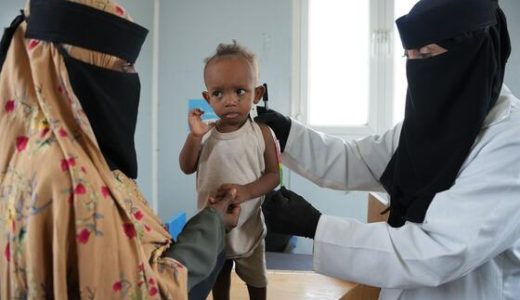
The strikes land against a backdrop of acute food insecurity. At least 18 million Yemenis already lack reliable access to adequate nutrition, Türk noted, warning that damage to civilian infrastructure — ports, fuel depots, hospitals — threatens to push an already catastrophic humanitarian situation past the point of recovery. The country’s political and humanitarian crisis, whose roots trace back to the upheaval of 2011, has displaced millions, shattered the economy, and left roughly 20 million people dependent on external humanitarian assistance.
UN Special Envoy for Yemen Hans Grundberg briefed the Security Council last week on the maritime dimension of the crisis. He cautioned that Houthi attacks on commercial shipping endanger global trade routes while simultaneously jeopardizing the fragile truce that has largely held since 2022. The Bab el-Mandeb corridor carries a significant share of world oil and container traffic; sustained disruption there would ripple through shipping insurance rates, freight costs, and supply chains far beyond the Arabian Peninsula.
On the domestic military front, reports indicate that forces aligned with the Yemeni Government executed nearly 200 strikes on Houthi positions within a single 24-hour window. Those operations killed and wounded dozens of fighters and destroyed military equipment and weapons depots, signaling that the government side is responding with considerable force. The combination of Houthi long-range strikes and government counter-operations raises the prospect of a renewed full-scale exchange — precisely the scenario UN officials are working to prevent.
For ordinary Yemenis, the arithmetic is simple: every missile that finds a port, a camp, or a hospital removes another layer of already scarce protection. The international community’s attention, focused elsewhere on the Iran–US confrontation, risks leaving a population of over 30 million people to absorb the consequences of a conflict that has now spanned more than a decade without resolution.
Related Reading
Frequently Asked Questions
What is Yemen?
Yemen is the main topic of this guide. The article explains the context, practical details, and next steps readers should understand.
Why does Yemen matter?
Yemen matters because readers are looking for a useful answer, not just a short summary. Good content should match search intent and help them decide what to do next.