Forensic testing gives wildlife trafficking cases a stronger foundation in Uganda
Provpnmatrix.com – A 10-kilogram package sent from Entebbe, Uganda, to Cairo raised an urgent question for authorities: were its thumb-sized fragments ordinary bone, or elephant ivory? The distinction is decisive in wildlife-crime investigations, where a visual inspection alone may not be enough to establish what has been seized.
Uganda’s United Nations-supported wildlife forensics laboratory is designed to help turn that uncertainty into evidence that can withstand scrutiny. By examining suspected wildlife products, the lab can assist investigators in identifying material recovered during seizures and strengthening the basis for criminal cases.
The shipment illustrates the practical challenge behind many trafficking inquiries. Small pieces of ivory can be difficult to distinguish from bone without specialist analysis, particularly when they have been cut, processed or packed for transport. What appears at first glance to be an unremarkable collection of fragments may carry major consequences for elephants, law-enforcement agencies and the people accused of moving prohibited wildlife products.
From suspicion to evidence
Seizures are an important first step, but they do not automatically produce convictions. Investigators must be able to show what a recovered item is, document how it was handled and present findings in a form that can be used in legal proceedings. Wildlife forensic work supports that process by bringing scientific examination into the investigation.
In the case of the package bound for Cairo, the suspected material weighed 10 kilograms and consisted of pieces roughly the size of a thumb. That scale of concealment underscores why laboratory capacity matters. A shipment does not need to contain intact tusks to warrant close attention; fragments can still be examined to determine whether they are consistent with elephant ivory or another material.
Forensic findings can help investigators move beyond an initial suspicion. Rather than relying solely on appearance, authorities can use technical analysis to clarify what was seized. This helps focus an investigation and can make the difference between a case that remains uncertain and one supported by evidence.
When suspected wildlife products are scientifically examined, a seizure can become a clearer legal case rather than simply an unresolved discovery.
A regional response to a cross-border crime
The route from Entebbe to Cairo also reflects the international nature of wildlife trafficking. A package can originate in one country, travel through commercial transport networks and be intended for delivery in another. That means enforcement depends not only on action at the point of departure, but also on cooperation across borders and on the ability to identify suspicious goods quickly and reliably.
Wildlife crime investigations often involve several connected stages: detection, seizure, identification, documentation and prosecution. Each stage has its own importance. If officers intercept a package but cannot establish the nature of its contents, the case may be weakened. If evidence is not properly connected to the investigation, the path to accountability can become more difficult.
A dedicated forensic laboratory gives authorities a more specialized tool for this work. It can support the examination of materials that may otherwise be hard to classify, helping investigators distinguish protected wildlife products from lawful substances that may look similar. In the Entebbe shipment, the central question was clear: bone or ivory. Scientific testing is intended to provide an answer grounded in analysis rather than assumption.
Why identification matters for elephants
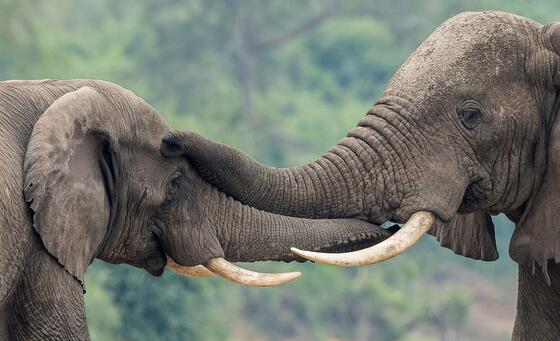
Elephant ivory remains a central concern in efforts to combat illegal wildlife trade. The movement of ivory in small pieces shows how trafficking can adapt to detection risks. Breaking material into fragments may make it less conspicuous than larger, recognizable items, but it does not remove the need for authorities to determine what it is or where it may be headed.
For readers, the importance of wildlife forensics may be easy to overlook because much of the work happens away from public view. It takes place in laboratories, evidence rooms and court processes rather than at the moment of interception. Yet that behind-the-scenes work helps ensure that wildlife protection is supported by demonstrable facts.
The laboratory’s role is therefore broader than identifying a single package. It contributes to the capacity of investigators and prosecutors to address suspected trafficking with stronger evidence. In cases involving material that could be either bone or ivory, that capability is especially valuable.
Building cases that can lead to accountability
The 10-kilogram shipment from Entebbe to Cairo demonstrates how a seemingly narrow forensic question can carry wider significance. Determining the identity of the fragments is essential not only for describing the seizure, but also for deciding how the case should proceed.
Scientific support does not replace the work of customs officers, investigators, prosecutors or courts. Instead, it adds a vital layer of certainty to their efforts. A seizure may begin with a suspicious package, but careful forensic analysis can help transform it into evidence capable of supporting action against illegal wildlife trade.
As trafficking networks continue to exploit transport routes and conceal wildlife products in different forms, laboratories equipped to examine contested materials remain an important part of the response. In Uganda, the UN-supported facility offers a practical means of helping authorities determine whether recovered fragments are simply bone or evidence of elephant ivory trafficking.
Related Reading
Frequently Asked Questions
What is Uganda s UN supported wildlife forensics?
Uganda s UN supported wildlife forensics is the main topic of this guide. The article explains the context, practical details, and next steps readers should understand.
Why does Uganda s UN supported wildlife forensics matter?
Uganda s UN supported wildlife forensics matters because readers are looking for a useful answer, not just a short summary. Good content should match search intent and help them decide what to do next.