‘The ocean has no boundaries’: Beauty and life in a war zone
The ocean has no boundaries – In early March, the Strait of Hormuz—long a vital artery for global oil trade—became a symbol of geopolitical tension after U.S. and Israeli military actions against Iran escalated into a full-scale crisis. The narrow waterway, no wider than 34 kilometers at its most constricted point, was suddenly under threat, with Iran declaring it closed to foreign vessels to disrupt the flow of seaborne crude. The closure left thousands of seafarers stranded in the Persian Gulf, while the UN Secretary-General urged an immediate pause in hostilities to prevent further escalation.
A rare return to the depths
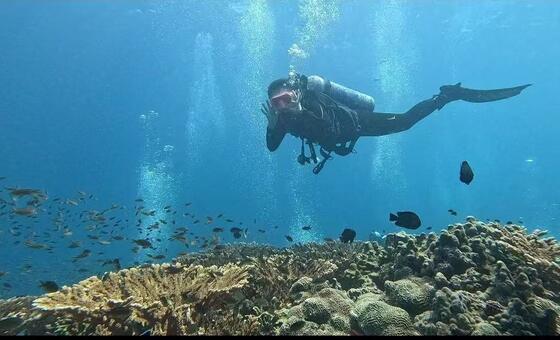
Three Chinese divers based in the UAE—Rui Li, a seasoned instructor; Shanshan Du, a freediver; and Jie Zhang, a technical diver—had been unable to explore the strait’s waters for weeks. The closure severed their access to the marine environment, halting their work and disconnecting them from the rhythms of the ocean. When limited access was restored in mid-April, they quickly reentered the depths, seizing the chance to witness life in a region once shadowed by conflict.
World Oceans Day, observed annually on 8 June, this year focuses on redefining humanity’s connection to the sea. For these divers, the theme is deeply personal. Their return to the strait’s waters, just days after the UN confirmed Iran’s commitment to opening the channel for commercial traffic during the ceasefire, has become a testament to the ocean’s resilience—and the fragile balance between human conflict and natural harmony.
Peace, dolphins, and a fading blue
“Before heading into the water, I was a bit nervous,” recalls Du, who ventured into the strait’s narrowest passage between the UAE and Oman on 18 April. “But after over two months of separation, it was incredible to finally dive again. I saw a massive pod of dolphins, and the atmosphere was anything but warlike—just serenity and beauty.”
Despite the ceasefire, the divers found traces of the conflict lingering beneath the waves. Zhang, who recently explored the area, notes a striking change in the underwater landscape. “The coral diversity here is unlike anything I’ve seen before,” she says, describing a vibrant tapestry of soft and hard corals shaped by the strait’s unique geography. Sea turtles, she adds, gathered in such numbers that it felt like a protected sanctuary—yet their presence was overshadowed by something more troubling.
“I noticed more white debris on the seabed than before,” Zhang explains, unsure of its source. “When we followed dolphins near the eastern side of the strait, the water around them was streaked with green algae, oil fumes, and floating trash. It was a heartbreaking sight, especially since the sea once felt so pure.”
For Li, the strait represents a dual reality: a place of extraordinary natural beauty and a battleground where human actions can have irreversible consequences. “This area isn’t the most biodiverse in the world, but its complex terrain supports coral reefs that are almost otherworldly,” he says. “There’s a silver needle-like whiteness and a purple hue reminiscent of pine forests. Even seahorses and whale sharks thrive here, species that rarely appear elsewhere.”
Yet Li also sees the ocean as a silent witness to human destruction. “If an attack on oil facilities were to happen, the damage to marine life could be catastrophic,” he warns. “These creatures are small and vulnerable. One strike might be enough to erase some species from existence forever.”
Boundaries dissolve in the deep
While on the surface, the strait is a site of political brinkmanship, its waters reveal a different story. Du, who dives in a region where people from dozens of nations coexist, emphasizes how the ocean transcends borders. “Underwater, the concept of nationality feels irrelevant,” she says. “We communicate through gestures, and the only thing that matters is the shared space we inhabit.”
“The ocean has no boundaries,” Zhang adds. “Currents flow freely, and fish schools move without regard for national lines. When whale sharks travel through different countries on their migratory routes, they are not bound by the conflicts above. This is a reminder that humanity should not tear apart the blue world, but instead cherish it as a shared home.”
Li offers a more metaphorical perspective, likening the ocean to a parent. “The relationship between people and the sea is like that between a child and a guardian,” he says. “The ocean sustains us, nurtures us, and sometimes disciplines us. We’ve grown old enough to recognize our responsibility, but the extent of what we can do remains limited. It’s as if our parents are still waiting patiently, offering guidance even as we struggle to protect them.”
The divers’ experiences highlight a growing awareness of the ocean’s role in connecting humanity. Zhang, who has spent time documenting the strait’s ecosystems, describes a scene that underscores this duality. “The sea is a mirror of our actions,” she says. “It absorbs the disputes, wars, and pollution we create on land, yet it has no ability to defend itself. Every debris we see is a testament to human carelessness.”
As the conflict continues to shape the region, these divers’ return to the strait’s waters serves as a quiet but powerful statement. Their observations, while personal, reflect a universal truth: the ocean remains a constant, even as the world above it trembles. In the depths, life persists, offering a fleeting glimpse of beauty that contrasts sharply with the turbulence on land. Their dives are not just acts of exploration, but a plea for harmony—a reminder that the ocean’s boundaries are not as rigid as those drawn by nations in their struggle for dominance.
For the three divers, the experience has redefined their understanding of the sea. Du, who once dreamed of chasing dolphins in untouched waters, now sees the ocean as both a sanctuary and a casualty of war. Zhang, who had witnessed the strait’s vibrant ecosystems before the closure, feels a renewed urgency to protect them. And Li, who had always viewed the ocean as a source of inspiration, now sees it as a symbol of resilience in the face of human conflict.
Their stories, though individual, weave a collective narrative. In the Strait of Hormuz, where history and nature collide, the ocean remains a space of peace. Yet its tranquility is fragile, and the divers know that one misstep could unravel the delicate balance they have fought to preserve. As they surface from the depths, they carry with them a message: the ocean has no boundaries, but it has limits—and those limits are being tested daily.