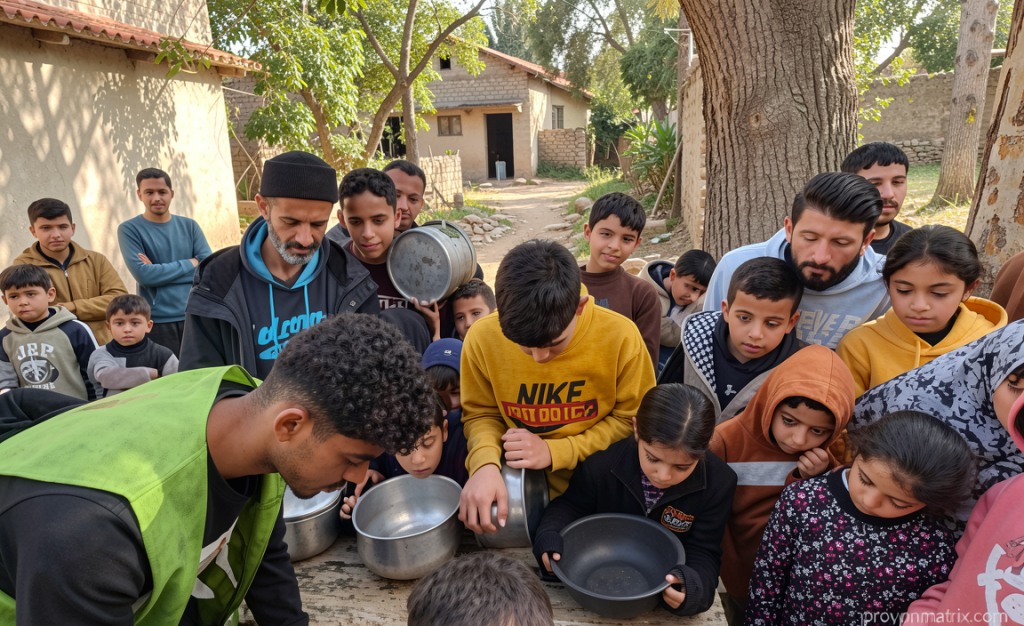
Food Shortages and Displacement Define Daily Life in Gaza as Aid Efforts Struggle to Keep Pace
Provpnmatrix.com – More than two million residents of the Gaza Strip — essentially the territory’s entire population — have been forced from their homes, most now sheltering in temporary structures or fragile shelters that offer little protection from the elements. Roughly ninety per cent of civilian infrastructure, spanning residential buildings, hospitals, water treatment facilities, and schools, stands heavily damaged or outright destroyed. Against this backdrop of near-total physical devastation, the question of whether families can secure even a single daily meal has become the defining humanitarian crisis of the territory.
One Meal a Day: The Scale of Household Hunger
UN data compiled in recent weeks paints a stark picture of caloric deprivation. Approximately one in five households in Gaza now reports consuming only a single meal per day. Half of all families surveyed indicated that their food stores were entirely exhausted at least once during the preceding thirty-day period. These figures are not the product of a single shock event but rather the cumulative result of compounding pressures: household cash reserves have been depleted, and the price of staple food items has climbed exponentially since hostilities escalated in October 2023.
The economic squeeze operates on two fronts simultaneously. Families that once managed modest grocery budgets now find that even basic staples cost multiples of their pre-war prices. At the same time, income-generating activity has collapsed across the Strip, leaving most households without the liquidity needed to purchase what little food remains available on local markets. The intersection of collapsing purchasing power and surging prices creates a feedback loop in which each successive month deepens nutritional deprivation.
Market Access: Three-Quarters of Households Locked Out
Compounding the affordability crisis is a physical access problem. The UN’s World Food Programme (WFP) reports that, within the current month, approximately seventy-five per cent of Gaza households have encountered difficulties reaching functioning markets. Security restrictions, damaged road networks, and intermittent military activity all contribute to the fragmentation of commercial supply chains. For families already stretched to the breaking point, the inability to walk to a functioning shop transforms a price problem into an outright deprivation event.
Aid Logistics Through Kerem Shalom
On the most recent delivery day, UN agencies and their implementing partners unloaded hundreds of pallets of humanitarian cargo at the Kerem Shalom crossing. This checkpoint, situated at the tri-junction where Israel, Egypt, and the Gaza Strip meet, serves as the principal commercial and humanitarian gateway into the territory. Without its operation, the pipeline of food, medical supplies, and fuel that sustains the aid programme would effectively close.
The cargo manifest for recent convoys spans a wide range of necessities: fresh fruits and vegetables, packaged food items, wheat flour for household baking, adult incontinence products, school supplies for children returning to interrupted education, and fuel for generators and transport. The diversity of the load reflects the breadth of needs that a single delivery must address when conventional commerce has largely ceased to function.
The August Cycle: Reaching Over Six Hundred Thousand People
As part of the August distribution cycle, partner organisations have already delivered food parcels and wheat flour to more than six hundred thousand individuals across the Strip. The monthly cycle structure means that aid arrives in discrete waves rather than as a continuous stream, creating windows of vulnerability between distributions. For families already subsisting on one meal a day, the gap between cycles can mean days without any caloric intake at all.
Ceasefire on Paper, Conflict on the Ground
A ceasefire agreement signed by Israel and Hamas in October 2025 was intended to halt large-scale fighting and open space for reconstruction. In practice, ongoing hostilities and layered security restrictions continue to impede local movement, constrain recovery operations, and interrupt supply routes. Frequent Israeli military strikes remain a recurring feature of daily life across the Strip, killing and displacing residents in cycles that outpace the capacity of shelters and medical facilities to absorb new arrivals.
The practical implication for food security is direct: every new displacement event severs a household’s remaining access to stored food, local markets, and distribution points. Every strike that damages a warehouse, a bakery, or a transport corridor removes capacity from an already crippled supply system. The aid pipeline, however determined its operators, must contend with a moving target of need that expands faster than logistics can scale.
What Comes Next
The convergence of near-total infrastructure loss, sustained displacement, collapsing household incomes, and surging food prices places Gaza’s civilian population in a category of vulnerability that few comparable crises have matched in density. The August cycle’s reach of over six hundred thousand beneficiaries, while substantial, represents a fraction of the two million displaced. Closing that gap requires not only continued physical access through crossings such as Kerem Shalom but also a durable reduction in active hostilities that would allow markets to reopen, supply chains to stabilise, and families to transition from emergency rations to ordinary food procurement.
Until those conditions materialise, the daily arithmetic for millions of Gazans remains brutally simple: one meal, if any, and the uncertain prospect of a second.
Related Reading
Frequently Asked Questions
What is Aid reaches hundreds of thousands in Gaza?
Aid reaches hundreds of thousands in Gaza is the main topic of this guide. The article explains the context, practical details, and next steps readers should understand.
Why does Aid reaches hundreds of thousands in Gaza matter?
Aid reaches hundreds of thousands in Gaza matters because readers are looking for a useful answer, not just a short summary. Good content should match search intent and help them decide what to do next.