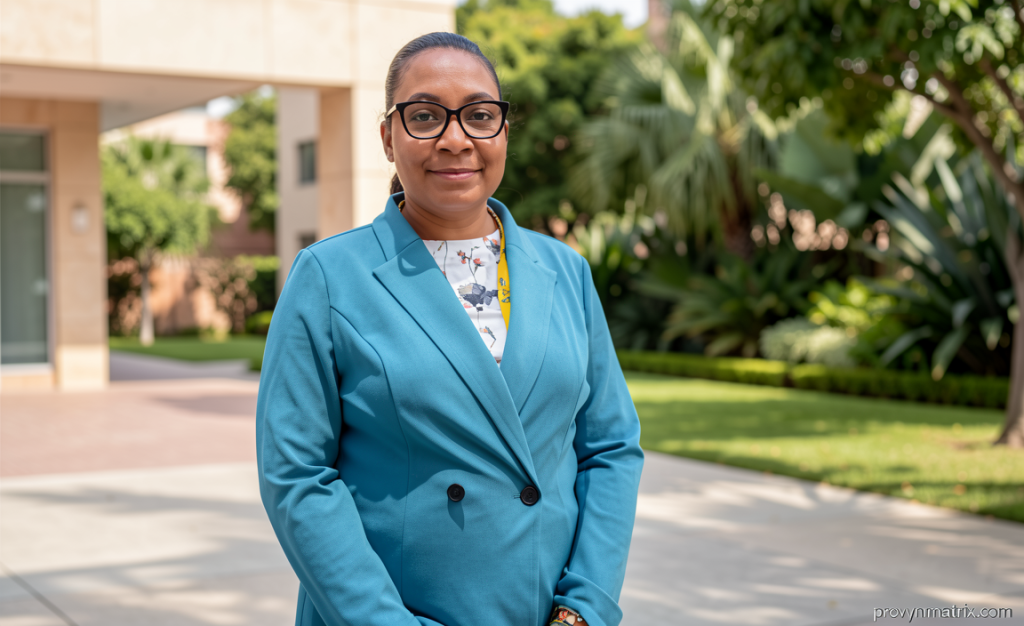
From Space Engineering to Global Education: Nia Jetter’s Mission to Democratize AI
A Childhood Spark That Led to the Stars
From NASA to the classroom – For twenty years, Nia Jetter dedicated herself to constructing spacecraft and developing robotic systems. Today, she channels that same passion into ensuring the artificial intelligence transformation reaches every corner of society, leaving no community behind.
Her journey began in New Jersey, where a young girl collected coins from her grandfather—not to purchase candy, but to acquire batteries and light bulbs. With these humble materials, she assembled electrical circuits using whatever components she could discover in her neighborhood.
Her parents played crucial roles in nurturing her curiosity. Her father regularly accompanied her to the local library to gather supplies, while her mother, who worked as both a kindergarten and special education instructor, modeled how to communicate sophisticated concepts in accessible ways.
From MIT to Amazon: Building a Remarkable Career
Three decades after those early experiments, Jetter had contributed to constructing the GPS satellite constellation that billions now rely upon daily. Her professional path took her through NASA, Boeing, and Raytheon before landing her at Amazon in one of the company’s most prestigious technical roles: senior principal technologist specializing in robotics artificial intelligence—a position held by only a select few engineers globally.
“I studied artificial intelligence before it was as cool as it is now,” she reflected, noting how the field has evolved from academic pursuit to mainstream phenomenon.
Her academic foundation came from the Massachusetts Institute of Technology, where she pursued mathematics and computer science with a focus on planetary science. She subsequently earned a master’s degree in aeronautics and astronautics from Stanford University, spending two decades developing autonomous algorithms for spacecraft and robotic systems.
Recognizing a Gap in the AI Revolution
Despite reaching the pinnacle of her profession, Jetter felt something was missing. “This moment in time is so important for the world because of how AI is shaping our society and how people are shaping AI,” she explained. “If we do not have all the right voices in the room shaping artificial intelligence…the product we end up with will not be the best one for us as a global community.”
This realization prompted a career pivot. Rather than continuing in traditional aerospace roles, she chose to ensure marginalized communities gained access to emerging technologies.
thinqueBytes: Making AI Accessible to All
Thus emerged thinqueBytes, initially launched as a personal initiative over five years before becoming part of the Distinguished Minds Institute. The organization’s core mission focuses on expanding artificial intelligence and STEM education opportunities among populations historically overlooked by the technology sector.
So far, the program has educated more than one thousand young people spanning four continents. The methodology is straightforward: transform complicated subjects—artificial intelligence, robotics, rocket science—into brief video segments called “bytes,” each addressing a fundamental question. What exactly is artificial intelligence? Should ordinary people feel concerned about it? Could automation eliminate jobs?
For Jetter, comprehending emerging technology “should not be a privilege; it should be a right.”
Personal Experience Shapes Her Vision
Jetter’s commitment stems partly from her own educational journey. She attended an engineering institution where, as she noted, “there were definitely more men than women,” and encountered resistance from individuals uncomfortable with alternative perspectives—perspectives that often represent “brilliant people who deserve a place in this world.”
She rejects naive technological optimism, comparing AI to a hammer: “In the right hands, it builds a house, protects people and saves lives. In the hands of someone very different, it can be used to cause harm.”
This perspective drives her belief that regulatory frameworks matter—not as barriers, but as navigational tools helping society understand when and how products might create negative consequences.
Shaping Global AI Governance
In early July, Jetter’s work intersected with international policy. She and her colleagues participated in the United Nations’ inaugural Global Dialogue on AI Governance in Geneva—the first UN General Assembly-created forum addressing artificial intelligence with representation from every nation.
During the summit’s opening, Secretary-General António Guterres emphasized that properly utilized AI, distributed equitably, could “compress decades of development into years” and emerge as “the great equaliser of the twenty-first century.” He cautioned that humanity faces a choice: “govern by design or drift by default.” He highlighted that 2.2 billion people—one quarter of the global population—remain entirely disconnected from digital connectivity.
ITU Secretary-General Doreen Bogdan-Martin reinforced this message, asserting that for AI to serve everyone, technological advancement and international collaboration must progress simultaneously.
Days afterward, at the AI for Good Global Summit where Jetter also presented, discussions became more tangible—focusing on artificial intelligence applications for early cancer detection, expanding internet access to distant schools, and cultivating critical-thinking capabilities for a generation raised alongside machines.
Jetter could easily resume her former career at any moment. Instead, she finds fulfillment knowing that somewhere in a Ghanaian classroom, or displayed on screens worldwide, individuals who once believed understanding artificial intelligence was beyond their reach are now learning to shape its future.