Ebola in Congo Accelerates Beyond Containment Capacity as Funding Shortfall Deepens
Provpnmatrix.com – The Democratic Republic of the Congo is battling the most rapidly expanding Ebola epidemic ever recorded, and the international community’s response, while expanding, is still trailing the virus’s exponential growth curve. UN Emergency Relief Coordinator Tom Fletcher issued a stark warning on Tuesday that without an immediate and substantial escalation of resources, the outbreak will continue to claim lives at an accelerating pace.
The situation has deteriorated sharply since the Bundibugyo-strain outbreak was formally declared on 15 May. Within the first hundred days of that declaration, health authorities documented 5,515 confirmed infections and 2,642 fatalities. By the following Monday, those figures had climbed to 6,100 confirmed cases and 2,950 deaths, with Ituri Province alone accounting for more than 5,000 of the infections. The speed of transmission has outstripped every prior Ebola emergency in the region.
A Comparison That Underscores the Scale
To grasp the magnitude of the current crisis, consider the 2014–2016 West African epidemic that affected Guinea, Liberia, and Sierra Leone. During the first hundred days of that outbreak, the World Health Organization confirmed just 635 cases and 399 deaths across the three nations combined. The DRC’s hundred-day toll exceeds those West African figures by nearly nine-fold in cases and more than six-fold in deaths, all within a single country and a single province-adjacent corridor.
Fletcher acknowledged that the UN and its implementing partners have already intensified their operational footprint on the ground. Yet a funding shortfall of approximately $1.1 billion persists, leaving critical gaps in treatment capacity, surveillance coverage, and community-level prevention. The gap represents the difference between a contained epidemic and one that metastasizes into neighbouring provinces and countries.
“The response is growing and has been scaled up, but the virus is moving faster. And unless we scale up urgently, more lives will be lost and the threat will grow.”
Regional Lessons and Cross-Border Monitoring
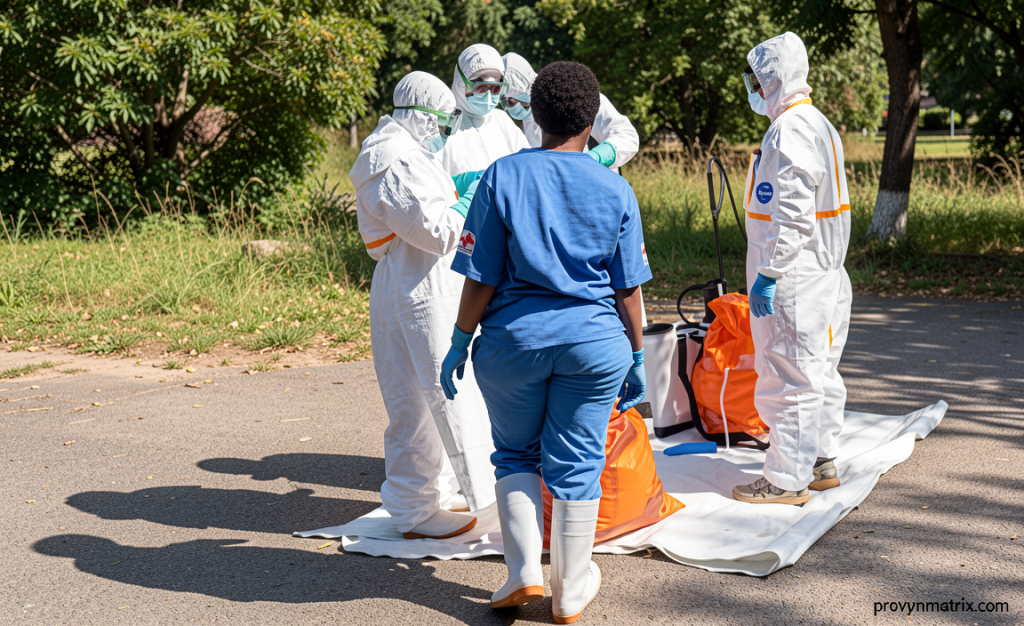
Not far from the epicentre, Uganda offers a recent counter-example. The WHO last week formally closed the country’s most recent Ebola outbreak, crediting a combination of rapid case detection and laboratory confirmation, aggressive contact tracing, isolation protocols, clinical management, infection-prevention measures, sustained community engagement, and reinforced surveillance systems. That playbook, Fletcher noted, remains the template for what the DRC response must achieve at scale.
Meanwhile, the International Organization for Migration has carried out nearly 23 million health screenings across the DRC and adjacent states. UN Spokesperson Stéphane Dujarric explained on Tuesday that these screenings serve a dual purpose: they track population movements and flag potential cases before they cross borders, thereby reducing the probability of secondary introductions into already-strained health systems.
To shore up the operational budget, Fletcher has directed more than $57 million from the UN’s donor-funded Central Emergency Response Fund toward Ebola response and preparedness activities in the DRC and its neighbours. That sum, while significant, addresses only a fraction of the $1.1 billion gap.
Conflict Compounds the Health Emergency
The outbreak is unfolding not in a vacuum but atop an already severe humanitarian crisis concentrated in eastern Congo. Armed clashes between Government forces and Rwanda-backed M23 rebels have displaced entire communities, severed supply routes, and made it extraordinarily difficult for health workers to reach isolated populations. Fletcher was explicit about the layered nature of the emergency:
“It is not simply a health emergency. It is also a humanitarian emergency layered onto many existing humanitarian emergencies.”
The UN peacekeeping mission MONUSCO recently intervened amid clashes involving the Congolese Armed Forces, Ugandan troops, and suspected members of the Allied Democratic Forces, an insurgent group affiliated with the Islamic State and based in the east — precisely the region where the record outbreak is centred. MONUSCO has also expanded programmes enabling more than 60,000 people to safely reach farmland and schools in Djugu territory, supporting protection operations and creating conditions under which displaced families might eventually return home, Dujarric added.
The Political Imperative
Fletcher’s closing appeal was directed squarely at national governments and the broader international community. He urged leaders to guarantee unhindered humanitarian access to affected populations and to keep the outbreak at the top of the diplomatic agenda, arguing that sustained political commitment and a coordinated multilateral response are prerequisites for closing both the funding gap and the epidemiological gap.
“We have the experience, the tools and extraordinary people risking their lives to stop this epidemic. What we need now is political will, access and resources. We have beaten Ebola before, and we can do it again.”
The historical record supports that confidence. Multiple prior outbreaks across Central and West Africa were ultimately contained, often within weeks of declaration, when political attention translated into rapid resource mobilization. The question now is whether the international community will replicate that speed of decision in a context where the virus is already weeks ahead of the response curve and where armed conflict continues to fracture the very infrastructure that containment depends upon.
Related Reading
Frequently Asked Questions
What is Response must outpace spread of Ebola?
Response must outpace spread of Ebola is the main topic of this guide. The article explains the context, practical details, and next steps readers should understand.
Why does Response must outpace spread of Ebola matter?
Response must outpace spread of Ebola matters because readers are looking for a useful answer, not just a short summary. Good content should match search intent and help them decide what to do next.