China Calls for Stronger Multilateralism at UN General Assembly
Provpnmatrix.com – China’s Vice President Han Zheng used his address to the United Nations General Assembly to argue that the international system created after the Second World War must be protected at a time of growing conflict, economic inequality and pressure on global cooperation.
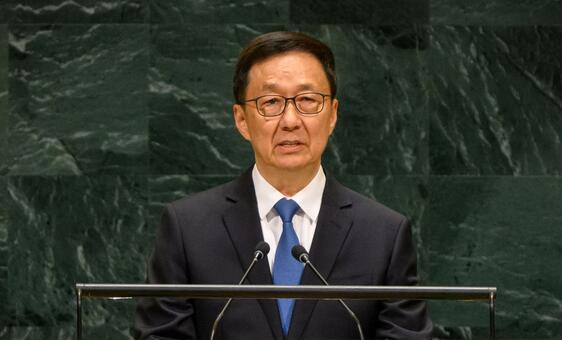
Speaking during the General Debate of the Assembly’s 81st session on Saturday, Mr. Han said governments face a choice between cooperation rooted in international law and a return to power politics. He presented the United Nations as the central institution for managing disputes and defending shared rules.
“The world wants peace not war,”
Mr. Han said the UN-centred system and the legal framework that developed after World War Two remain essential. In his view, countries should resolve disputes through dialogue and negotiation, rather than resorting to military action without Security Council authorization.
He said larger powers carry particular obligations because of their influence over global peace and security. Those countries, he argued, should demonstrate respect for rules, legality and fairness rather than treating international commitments selectively.
Conflicts in the Middle East and Ukraine
Addressing regional crises, Mr. Han called for respect for the sovereignty of states across the Middle East, including nations in the Gulf. He said Gaza’s reconstruction should follow the principle that Palestinians govern Palestine and linked any lasting solution to renewed progress toward a two-state settlement.
On the war in Ukraine, he referred to four points proposed by President Xi Jinping, describing them as the basis for China’s continuing effort to contribute to a political resolution in its own way. He did not set out the four points in the speech, but framed dialogue as the route to ending the crisis.
Mr. Han also urged an immediate end to the blockade and sanctions imposed on Cuba, placing that appeal within his broader criticism of unilateral measures outside multilateral processes.
Development, Trade and Climate Finance
Much of the address focused on the uneven distribution of development opportunities. Mr. Han called for an international partnership founded on equality, solidarity and inclusiveness, with particular attention to reducing poverty, ensuring access to food and supporting the transition to cleaner energy.
He said developed countries should meet their development-financing and climate-finance pledges. The issue remains significant for many lower-income countries, which have pressed wealthier states to deliver resources needed for adaptation, resilience and sustainable growth.
Mr. Han also defended the multilateral trading system, warning that protectionist policies ultimately benefit no one. He urged support for a World Trade Organization-centred approach to trade, arguing that open and predictable economic links are important to global development.
China has positioned its own economic role as part of that wider development agenda. Mr. Han said the country has accounted for roughly 30 per cent of global growth in recent years, while more than $23 billion has been mobilized through the Global Development Initiative. He added that China has granted zero-tariff treatment to all African countries and least developed countries with which it maintains diplomatic ties.
Artificial Intelligence and Cultural Exchange
Artificial intelligence was another major theme. Mr. Han said AI policy should place people at its centre and ensure technological progress serves beneficial purposes. He called for action to reduce the digital divide, warning implicitly that unequal access to technology could deepen existing disparities between countries and communities.
“[The world] should take a people centered approach and develop AI for the positive and for good, narrow the digital divide and promote development that is universally beneficial.”
He also argued for greater respect between cultures. Diversity, he said, has enriched the world, while attitudes of superiority and self-interest undermine constructive relations among civilizations.
UN Reform and the Global South
Reaffirming Beijing’s support for the United Nations, Mr. Han described multilateralism as a response forged by humanity’s experience of devastating conflict. He said fairness and justice remain common aspirations across countries.
China supports reform of the UN, he said, but wants changes that reinforce the organization’s capacity instead of simply reducing institutions, mandates or resources. He also called for a stronger voice for the Global South in international decision-making, reflecting long-running demands from developing nations for greater representation in global governance.
Mr. Han praised Secretary-General António Guterres, whose term ends in late 2026, and outlined qualities China hopes to see in the next UN leader. He said the successor should respect the UN Charter, possess exceptional ability, maintain integrity and impartiality, and show courage and commitment.
China’s UN Role
The vice president also marked 55 years since General Assembly resolution 2758 was adopted on 25 October 1971. The resolution recognized the Government of the People’s Republic of China as China’s sole legitimate representative at the United Nations.
Since joining the UN in that capacity, Mr. Han said China has acted as a stabilizing influence during periods of volatility. He said the country has maintained the strongest peace-and-security record among major powers and has made the largest peacekeeping contribution of any permanent member of the Security Council.
His remarks combined a defence of the existing postwar order with a call to reshape global governance so that developing countries have greater influence. The underlying message was that international cooperation, rather than unilateral action or economic fragmentation, should guide responses to war, climate pressures, technological change and development needs.
“China will join hands with all other countries to build a community with a shared future for humanity and make the world a better place for all of us,” Mr. Han said.
Related Reading
Frequently Asked Questions
What is Safeguard the postwar order China tells?
Safeguard the postwar order China tells is the main topic of this guide. The article explains the context, practical details, and next steps readers should understand.
Why does Safeguard the postwar order China tells matter?
Safeguard the postwar order China tells matters because readers are looking for a useful answer, not just a short summary. Good content should match search intent and help them decide what to do next.