Ebola’s Grip Tightens in Congo as Funding Gap Threatens Containment
Provpnmatrix.com – The Democratic Republic of the Congo is battling one of the most severe Ebola epidemics in recent memory, and the international community’s financial commitment has not kept pace with the virus’s relentless advance. Speaking at UN Headquarters on Thursday, the Secretary-General described the Bundibugyo strain outbreak as demanding “urgent” intervention, warning that the humanitarian machinery designed to halt transmission is running on fumes. Since the first cases surfaced in mid-May, more than 5,600 infections and 2,700 deaths have been recorded across six provinces, a toll that continues to climb at roughly 500 new cases per week.
A Trend That Has Slowed but Not Reversed
The World Health Organization has indicated that its containment measures have managed to decelerate the epidemic’s velocity, yet the trajectory has not yet been turned around. The distinction matters: slowing a curve is not the same as flattening it, and every week of delay compounds the strain on already stretched health systems. The agency’s assessment underscores that the window for effective intervention is narrowing even as the virus finds new footholds in communities with little prior experience of Ebola.
The Funding Chasm
At the heart of the crisis lies a stark arithmetic problem. The humanitarian response currently stands at just 48 per cent of its required funding level. The Secretary-General was blunt about the consequence:
“Without additional funding, vital operations will run out of money at the very moment they need to ramp up.”
He called for an additional $1.1 billion to close the gap. Existing resources, by most estimates, will sustain operations for only a matter of weeks rather than the months the epidemic’s duration demands. The mismatch between the pace of spread and the pace of response creates a dangerous feedback loop: as cases multiply, the cost of containment rises precisely when donor fatigue sets in.
“We know how to contain Ebola, how to interrupt transmission and how to save lives,” the Secretary-General added, “but we must also overcome another virus: the virus of indifference.”
Conflict as a Force Multiplier
Ebola does not spread in a vacuum. It moves through a region scarred by decades of armed conflict, where entire populations have been uprooted and health infrastructure reduced to skeletal remnants. In Ituri province alone, the epicentre of the current outbreak, approximately one million people have been displaced. Across the wider region, more than 12 million individuals require humanitarian assistance and protection, a figure that dwarfs the epidemic’s own casualty count and complicates every aspect of disease surveillance.
Insecurity is not merely a backdrop; it is an active obstacle. More than 40 healthcare workers have been killed in the line of duty. Treatment centres have come under attack, and ambulances carrying patients or supplies have been targeted. Field teams must therefore contend simultaneously with a viral pathogen and with armed violence, while certain communities remain physically inaccessible due to ongoing hostilities. Each lost worker deepens an already acute staffing shortage, and each destroyed facility removes a node from the fragile network of care.
Community Voices in the Fight
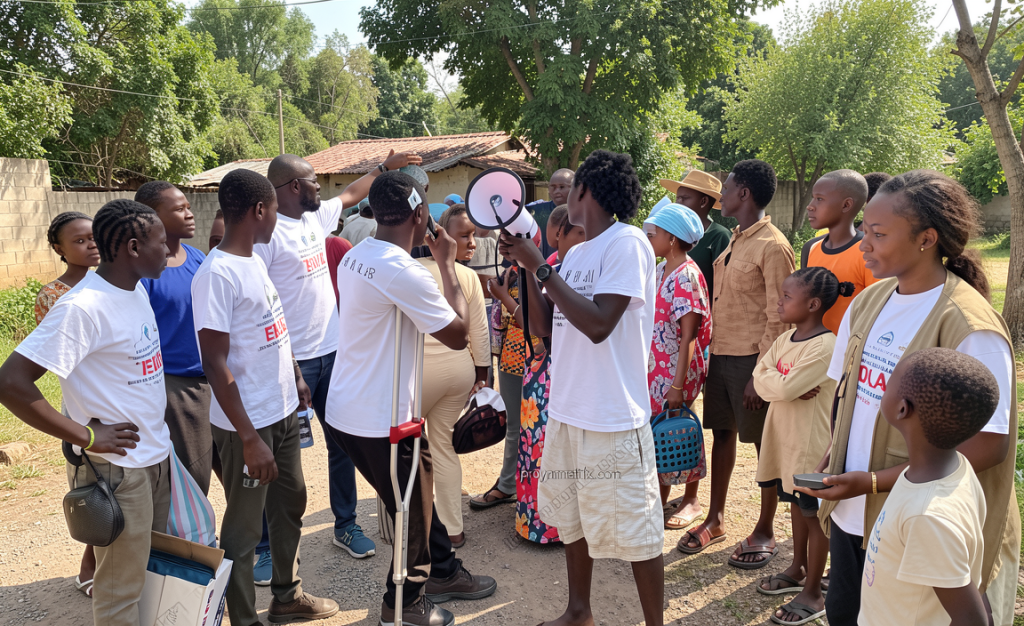
Recognizing that biomedical intervention alone cannot halt transmission, a broad coalition of local actors has entered the public-health effort. Renowned Congolese singer and songwriter Lokua Kanza, who serves as a national UNICEF ambassador, posted a video urging residents to adopt preventive measures such as handwashing, safe burial practices, and avoidance of unnecessary contact with symptomatic individuals. The popular duo Wedy and singer Drigo Eboma have each released music calling on listeners to break chains of transmission. Fifteen social-media influencers, each commanding audiences of over 100,000 followers, have deployed their platforms to reach younger demographics who may be less exposed to traditional public-health messaging.
Religious institutions have been drawn into the effort as well. More than 50 faith leaders in Ituri province received briefings on prevention protocols and on strategies for countering rumours that can erode trust in vaccination and treatment. In a parallel initiative, approximately 30 former combatants underwent specialized training from UN partners and local authorities on prevention measures and early detection of suspect cases. They were then dispatched to heavily trafficked areas north of Ituri, where their familiarity with local terrain and social networks gives them an advantage over outside responders.
Burundi Braces for the Worst
Neighbouring Burundi has not yet reported a confirmed case, but its geographic adjacency to affected DRC provinces and the continued cross-border movement of people place it at elevated risk. UN humanitarian agencies and partners are supporting government-led preparedness measures already under way, including strengthened surveillance at entry points through temperature screening and the deployment of thermal scanners. Training programmes extend to nurses, community health workers, and journalists, ensuring that information flows accurately at the border and within communities most likely to encounter returning travellers.
Uganda Declares Its Outbreak Over
On the same day, UN health officials and partners announced that the Bundibugyo Ebola outbreak in neighbouring Uganda has officially ended. The declaration follows 42 consecutive days without a new confirmed case, counting from the discharge of the country’s last patient on 16 July. The 42-day benchmark—equivalent to twice the upper limit of Ebola’s incubation period—is the internationally established criterion for closing an outbreak.
During its course, Uganda recorded 20 confirmed cases, including two deaths. More than 800 close contacts were identified and monitored to ensure no further transmission occurred. The country’s experience, while smaller in scale than the DRC epidemic, illustrates how rapid contact tracing and community mobilization can contain a strain before it gains momentum.
Scaling Up Where It Matters Most
Back in the DRC, UN agencies and partners have begun expanding the response footprint. Thirty-five additional mobile safe-and-dignified burial teams and 286 community-based teams have been deployed to high-risk areas, supported by more than 2,500 volunteers and civil-protection personnel, according to the UN Office for the Coordination of Humanitarian Affairs. These units are critical because safe burial practices remain one of the most effective single interventions against household transmission, yet they require sustained, well-trained presence in communities where fear and misinformation can undermine compliance.
The convergence of factors—rapid case growth, chronic underfunding, active conflict, displaced populations, and weakened health systems—makes the DRC outbreak a test of whether the international humanitarian architecture can deliver at the speed the virus demands. The tools exist. The knowledge exists. What remains uncertain is whether the political will and financial resources will arrive before the epidemic outpaces them entirely.
Related Reading
Frequently Asked Questions
What is UN chief condemns indifference as Ebola?
UN chief condemns indifference as Ebola is the main topic of this guide. The article explains the context, practical details, and next steps readers should understand.
Why does UN chief condemns indifference as Ebola matter?
UN chief condemns indifference as Ebola matters because readers are looking for a useful answer, not just a short summary. Good content should match search intent and help them decide what to do next.