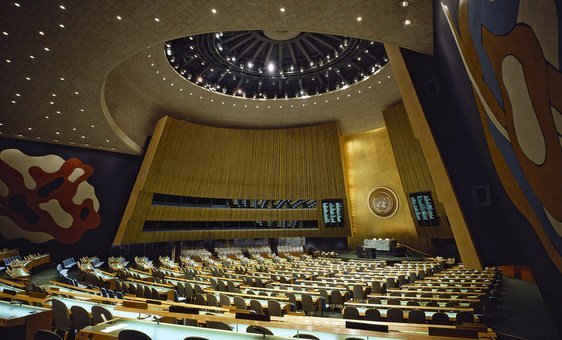
A forum shaped by conflict, independence and global debate
Provpnmatrix.com – More than 80 years after the United Nations was founded, the General Assembly continues to give all 193 Member States a place to address the world’s most urgent disputes and shared priorities. War, peace, economic development, climate action and human rights all feature in a body whose influence has repeatedly evolved beyond the expectations of its creators.
As leaders prepare to gather for the Assembly’s annual high-level week, its long history offers a reminder that international diplomacy is not confined to the Security Council. The Assembly has often become especially important when divisions among major powers prevent action elsewhere.
Richard Gowan, Director of UN and Multilateral Diplomacy at the International Crisis Group in New York, argues that this role emerged almost immediately after the organization began operating.
“I think the founders of the UN assumed that the Security Council would be the centre of most decision making in 1945. But after the UN started working, the big powers in the Security Council became divided very quickly, and suddenly a lot of political discussions moved to the General Assembly.”
When the Security Council was stuck
In the late 1940s and early 1950s, Cold War rivalry frequently immobilized the Security Council. Questions involving Palestine and Korea therefore received substantial attention in the General Assembly, which became a venue for political discussion when agreement between the United States and the Soviet Union proved impossible.
At that time, much of the Assembly’s membership was aligned with, or friendly toward, the United States. That balance enabled Washington to seek wider international backing through the Assembly during moments of Security Council deadlock, including discussions on the Korean War.
The Assembly faced a defining moment in 1956, when two major crises unfolded at once. Britain and France intervened in Egypt during the Suez Crisis, while the Soviet Union invaded Hungary. The Assembly’s response to Suez was historically significant: it authorized the first military UN peacekeeping operation, intended to help bring that conflict to an end.
That decision established one of the Assembly’s most consequential Cold War-era contributions to international crisis management. Although the Assembly does not operate in the same way as the Security Council, its ability to convene the entire UN membership has allowed it to shape political legitimacy, set agendas and create pressure for collective action.
Decolonization changed the Assembly
The scale and character of the General Assembly transformed during the 1960s as newly independent countries joined the United Nations. The organization’s founders had apparently imagined an Assembly of perhaps 80 or 90 states. Instead, decolonization brought a much broader range of governments into global decision-making.
For countries emerging from colonial rule, the Assembly provided a rare international platform from which to raise issues central to their peoples and regions. Apartheid in South Africa became one of the clearest examples. Throughout the 1960s, the Assembly adopted resolutions condemning apartheid, and in the 1970s it suspended apartheid South Africa’s membership.
“The General Assembly was a place where newly free countries could make their voices heard.”
The suspension reflected the growing political weight of what is now commonly described as the Global South. It also demonstrated that the Assembly could turn sustained debate into a powerful statement of international isolation, even where its resolutions did not carry the same enforcement mechanisms as Security Council decisions.
Former colonial states used the forum to focus attention on South Africa, continuing colonial conflicts such as Portugal’s presence in Africa, and Palestine, which became a more prominent Assembly issue during the 1970s. These debates connected national struggles for self-determination with wider questions about representation and fairness in world affairs.
Arguments over the global economy
The Assembly’s agenda was not limited to political and security crises. Developing countries also sought to challenge what they considered an unequal international economic system. In 1974, the Assembly adopted a resolution calling for a new economic order intended to be fairer to developing countries.
That demand led to difficult negotiations that continued through the 1970s and 1980s. The hoped-for new international economic order did not materialize, but the debate itself mattered. It put concerns about unequal economic power, development opportunities and the distribution of global resources at the center of multilateral diplomacy.
Gowan sees the Assembly’s Cold War role primarily through that broadening of political voice. Countries leaving colonial rule could make their positions visible on the world stage, even when their influence did not translate into every policy objective.
“I think without the assembly, the vast majority of UN Member States wouldn’t have had a voice on many global affairs.”
He also argues that the Assembly’s long campaign against apartheid had meaningful consequences. Its repeated condemnation and diplomatic pressure helped build the international momentum that contributed to apartheid’s eventual collapse in the early 1990s.
A continuing stage for diplomacy
The period after the Cold War offered diplomats more room to work across ideological divisions and discuss ways to strengthen the UN system. During the Cold War, contacts between diplomats from opposing blocs could be deeply constrained. The post-Cold War environment, at least initially, created more opportunities for practical cooperation.
Today’s international landscape is again marked by sharp geopolitical tension. That makes the General Assembly’s universal membership particularly relevant. It cannot erase rivalries or guarantee agreement, but it ensures that states large and small can speak, negotiate, form coalitions and define their priorities in public.
Its value lies partly in this persistence. The Assembly is a place where immediate crises are debated, but it is also where longer-term concerns—development, equality, human rights and climate change—can remain visible even when powerful governments disagree. For countries that might otherwise have limited influence over global discussions, that access remains one of the UN’s essential promises.
Related Reading
Frequently Asked Questions
What is Why the UN General Assembly still?
Why the UN General Assembly still is the main topic of this guide. The article explains the context, practical details, and next steps readers should understand.
Why does Why the UN General Assembly still matter?
Why the UN General Assembly still matters because readers are looking for a useful answer, not just a short summary. Good content should match search intent and help them decide what to do next.