For One Young Refugee in Uganda, Basketball is More Than a Game
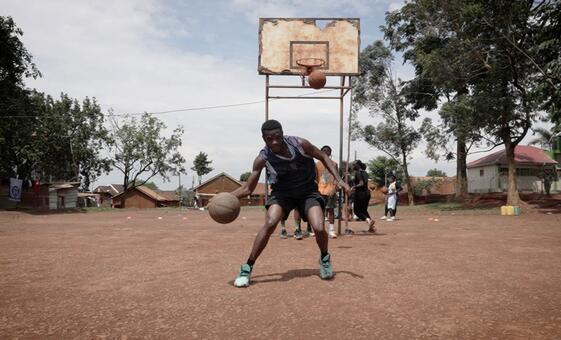
For one young refugee in Uganda – In the heart of Kampala, a bustling city in Uganda, 19-year-old Stephane Kulimushi leads a life that blends athleticism, education, and community service. Beyond the squeaks of sneakers and the swish of basketballs, his work with the Refugee Basketball Academy (RBA) has become a beacon of hope for thousands of displaced youth. Stephane, who arrived in Uganda as a refugee from the Democratic Republic of Congo (DRC), sees the court not just as a place for games but as a platform for transformation.
Refugees often arrive in Uganda with little more than the clothes on their backs, yet they bring with them resilience and a desire to thrive. Stephane’s journey mirrors that of many young people who have fled conflict and instability in the DRC. The challenges of resettlement—accessing education, finding stable employment, and building a sense of belonging—can feel overwhelming. For Stephane, this struggle is deeply personal. “When arriving here as a refugee, I found many challenges,” he shared in a recent interview. “I saw how easy it is for a young refugee to lose control of his future.”
Amid these obstacles, basketball has emerged as a lifeline. The sport provides structure, a sense of purpose, and a community where dreams can take root. Stephane’s academy, launched in 2020, is more than a sports program—it’s a holistic initiative designed to empower marginalized youth. “We do not just build basketball players, we are building leaders,” he emphasized, highlighting the program’s focus on mentorship and education alongside athletic development.
From Crisis to Purpose
Stephane’s commitment to change began with a simple realization: without direction, many young refugees risk falling into despair. He recalls the days when he first stepped onto the court, unsure of his place in the world. “I used to feel lost,” he admitted. “But basketball gave me something to focus on—something to believe in.”
That belief soon turned into action. Drawing upon the entrepreneurship training he received through the Cosmo Foundation, Stephane transformed a modest concept into a thriving program. Today, the Refugee Basketball Academy has trained over 100 players, offering them more than just skill development. It provides opportunities to connect with schools, explore career paths, and gain access to resources that might otherwise be out of reach.
The academy’s activities are diverse. Weekly practices, regional tournaments, and mentorship sessions create a network of support. But perhaps the most impactful element is the video recordings of players, which serve as a bridge to educational and professional opportunities. “These videos help them show their potential to others,” Stephane explained. “It’s a way to open doors they didn’t know existed.”
So far, the program has awarded seven scholarships, enabling students to continue their studies. For Stephane, this is just the beginning. His vision extends beyond the basketball court, aiming to create a movement that redefines the narrative around refugees. “Refugees are not just people waiting for help,” he said. “We are carrying talents with us.”
A Full-Time Commitment
Stephane’s days are packed with activities that reflect his dual role as a student and a community leader. He wakes before dawn to coach young athletes, then devotes the afternoon to his studies at Cavendish University, where he pursues a degree in management and entrepreneurship. By evening, he returns to the court to mentor the next generation. “Basketball gives young people structure, confidence, and a place to feel part of something,” he noted, underscoring the sport’s role in fostering unity and purpose.
For many refugee children and teenagers, the court represents more than a sport—it’s a refuge from the chaos of displacement. “It offers a rare sense of calm,” Stephane said. “In a world where everything is uncertain, the game is a constant.” This perspective is shared by participants, who describe the academy as a safe space where they can build friendships, set goals, and gain a sense of normalcy.
Stephane’s efforts are part of a broader movement to align sports with sustainable development. He believes that youth leadership is key to addressing global challenges, and the RBA serves as a model for integrating physical activity with education and mentorship. “We’re leaving houses,” he said, “but we’re carrying talents with us.” His words resonate with the thousands of refugees who have found solace and opportunity in the academy’s programs.
Expanding the Impact
Looking ahead, Stephane aims to scale the academy’s reach across Uganda. He envisions establishing similar initiatives in other refugee camps and communities, ensuring that more young people can access training, mentorship, and support. “The goal is to create a pipeline of leaders who can contribute to the 2030 Agenda,” he said, referencing the United Nations’ Sustainable Development Goals. “We want refugee youth to see themselves as valuable assets, not just as people in need.”
His message is clear: being a refugee should not define the end of someone’s dreams. Instead, it should mark the beginning of a new chapter. “The basketball court is where those dreams can start again,” Stephane reflected. This philosophy has inspired others to join his cause, as the academy continues to grow and evolve. Each participant is not only learning the game but also discovering their potential.
As World Refugee Day approaches, Stephane’s work takes on added significance. He uses this time to amplify his message, reminding the world that refugees are not just recipients of aid but active contributors to society. “We’re not waiting for help—we’re waiting to make a difference,” he said. This sentiment underscores the academy’s mission, which is to empower young people to shape their own futures.
For Stephane, the journey has been transformative. From a refugee seeking stability to a leader driving change, his story is a testament to the power of sport and education. “Every time I step onto the court, I feel like I’m doing something meaningful,” he said. “It’s not just about winning games—it’s about winning lives.”
His vision is not confined to Uganda. He hopes to one day take the model internationally, inspiring other regions to embrace similar approaches. “Sports can be a universal language,” he remarked. “It’s a way to connect, to teach, and to transform.” As the Refugee Basketball Academy continues to grow, so does its impact, proving that even in the face of adversity, hope and opportunity can flourish.