UN Secretary-General Urges Immediate Action on Hormuz and Security Council Reform
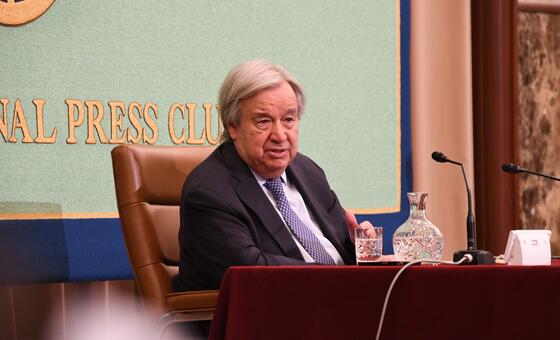
Security Council reform is absolutely essential – António Guterres, the United Nations Secretary-General, emphasized the urgency of addressing two critical global challenges during a press conference held on Wednesday. The first was the need to swiftly restore unimpeded maritime passage through the Strait of Hormuz, a vital artery for global energy supplies. The second revolved around the necessity of reforming the UN Security Council to ensure it reflects the contemporary geopolitical landscape and holds all nations accountable for their actions.
Japan’s Role in Global Diplomacy
Guterres spoke while concluding a formal visit to Japan, a nation that has maintained a sustained partnership with the UN for seven decades. The Secretary-General highlighted the importance of collaborative efforts in a world increasingly defined by conflict, environmental instability, and deepening social disparities. His remarks came against the backdrop of Japan’s ongoing commitment to international cooperation, particularly in the context of global peacekeeping and sustainable development initiatives.
Global Crises Intensify
Guterres drew attention to how rising inflation and the escalating cost-of-living crisis have been exacerbated by the current unrest in the Middle East. This turmoil has led to sharp price surges for essential resources such as energy and raw materials, including fertilizers. The UN chief stressed that these economic pressures are not isolated phenomena but are deeply intertwined with broader geopolitical tensions that threaten global stability.
“Countries are flouting international law with impunity,” Guterres stated. “Military spending is outpacing spending on aid, while funding cuts have devastating consequences for the world’s most vulnerable people.”
Security Council as a Core Issue
Guterres reiterated his long-held advocacy for overhauling the UN Security Council, calling it “the most important reform that needs to be established.” He argued that the existing structure—comprising five permanent members with veto power and ten non-permanent members elected for two-year terms—has failed to adapt to the complexities of the modern world. This outdated framework, he contended, undermines the organization’s ability to address emerging global challenges effectively.
The five permanent members—China, France, the United Kingdom, the United States, and Russia—retain unchecked authority to block resolutions, even in the face of widespread international consensus. Guterres pointed out that the absence of African and Latin American nations among the permanent members highlights a systemic imbalance in global representation. Asia, which constitutes half the world’s population, is also underrepresented, with only a single country securing a permanent seat.
Legitimacy and Effectiveness in Question
“This is a serious problem of legitimacy and of ineffectiveness,” the Secretary-General remarked. “It is absolutely essential to increase the number of permanent members and to expand the non-permanent membership to ensure the Security Council corresponds to today’s realities.” His comments underscored the growing perception that the Council’s structure no longer mirrors the distribution of global power or the needs of its member states.
Guterres also warned that the current system allows major powers to act with minimal oversight, creating a cycle of impunity. He cited the ongoing conflicts in regions such as the Democratic Republic of the Congo and Sudan as examples of how this dynamic has contributed to prolonged instability. “You see what happens in the DRC, you see what happens in Sudan. You see what happens in the Horn of Africa,” he said, emphasizing the need for a more inclusive and equitable multilateral framework.
Superpowers and the Crisis of Multilateralism
When asked whether international institutions like the UN could prevent conflict, Guterres clarified that “it’s not multilateralism that is in crisis.” Instead, he attributed the challenges to the behavior of superpowers that prioritize their own interests over collective action. These nations, he argued, often disregard international law, instigate conflicts, and wield their veto power to shield themselves from consequences.
“Because when the bad example comes from superpowers, other middle-sized powers all over the world think that they can do whatever they want, without any punishment,” Guterres explained.
He further warned that the Security Council’s inability to impose accountability on major powers has eroded its credibility. This, he said, has made it “very difficult for the Secretariat of the United Nations to contain the dramatic increase in the number of conflicts around the world.” The Secretary-General’s critique highlighted the growing disconnect between the Council’s authority and its practical effectiveness in maintaining peace.
Reforming for a Juster Global Order
Guterres called for a Security Council that better represents the diversity of the global community. He envisioned a system where nations from all regions have a voice in decision-making processes, ensuring that the Council’s actions align with the interests of the majority of its members. “A multilateral system that is more fair, more able to continue to defend international law and hold countries accountable to it” is what he believes the world urgently needs.
The UN chief reiterated that the organization’s strength depends on the collective commitment of its member states. While the UN remains a unique platform for advancing peace, sustainable development, and human rights, its effectiveness is constrained by the reluctance of powerful nations to embrace reforms that would enhance transparency and fairness.
Global Implications of Veto Power
Guterres’ remarks focused on the role of veto-wielding superpowers in perpetuating global inequalities. He argued that the unrestricted use of this power allows nations to override resolutions that address pressing issues such as humanitarian crises or climate change. This dynamic, he said, creates an environment where smaller states are left without recourse, while major powers continue to act with impunity.
He also underscored the importance of restoring freedom of navigation in the Strait of Hormuz, a region critical to global energy markets. “It is essential to immediately re-establish the freedom of navigation in and around the Strait of Hormuz, and to end all ceasefire violations and create conditions for a political solution to the conflict,” Guterres said. His statement reflected the immediate economic and security stakes of the region, where disruptions can have cascading effects on global trade and stability.
Pathways to a More Equitable System
The Secretary-General’s call for reform extends beyond the Security Council itself. He emphasized the need for broader changes to international institutions, including the global financial systems that govern economic policies. These institutions, he argued, must evolve to address the inequities of the current order, which disproportionately benefits a small group of nations while neglecting the needs of others.
Guterres concluded by reiterating that the success of the UN hinges on its ability to adapt to the changing world. “The global problem-solving architecture—particularly the Security Council and global financial institutions—is not as effective as it needs to be at this challenging moment,” he stated. His vision for reform is not merely about structural changes but about ensuring that the UN can fulfill its mission of promoting justice, peace, and cooperation on a global scale.
Conclusion: A Call for Collective Responsibility
Throughout his remarks, Guterres stressed that reform is not just a procedural necessity but a moral imperative. The Security Council, he argued, must become a more representative body to reflect the realities of the 21st century. By expanding its membership and granting more equitable influence to emerging powers, the Council can better address the challenges of today’s interconnected world.
His message served as a reminder that the UN’s authority is contingent on the willingness of member states to uphold its principles. “The Organization is only as strong as Member States’ commitment to it,” he noted. In a world where conflicts and crises continue to escalate, Guterres’ call for reform stands as a pivotal step toward a more just and effective global governance system.