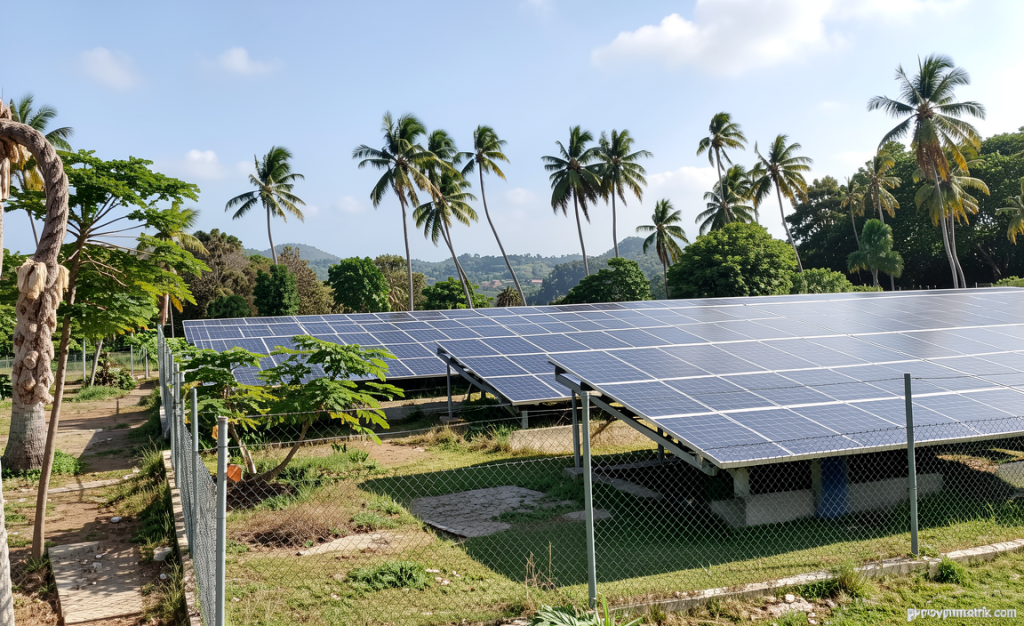
When Solar Farms Become Land Healers: The Growing Footprint of Clean Energy
Provpnmatrix.com – The global push to replace fossil fuels with wind, solar, and other renewables is set to multiply its physical land footprint roughly sixfold over the next decade. What currently occupies around 500,000 hectares worldwide is projected to swell to three million hectares by 2032. That staggering expansion raises an urgent question for planners, ecologists, and rural communities: can the very infrastructure built to combat climate change simultaneously mend the degraded ground it sits upon?
The question moved from abstract debate to concrete discussion this week in Ulaanbaatar, Mongolia, where delegates gathered for a United Nations conference on desertification. A dedicated side-event brought together scientists, policymakers, and development practitioners to examine how renewable-energy deployment might coexist with — and actively contribute to — land restoration. Case studies from South Africa, China, and India illustrated that the answer, in many contexts, is yes.
A Land-Use Shift of Historic Scale
Julian Blanc, who leads the Biodiversity and Land Branch at the UN Environment Programme (UNEP), framed the stakes plainly:
“The real question is no longer whether renewable energy is going to expand or not. It is, and the question is whether it expands in ways that leaves landscapes, ecosystems and people better off than before.”
He described the coming buildout as potentially “one of history’s largest land use transformations.” From photovoltaic arrays to the transmission corridors that carry their output, every component demands ground. The implication is that siting decisions made in the next few years will lock in land-use patterns for decades, making upfront ecological planning not optional but essential.
Deserts as Living Infrastructure: Lessons from China
Perhaps the most striking examples come from China’s arid interior, where solar installations are being woven into active sand-control and vegetation-restoration programmes. In the Taklamakan Desert, solar-powered pumps circulate water to irrigate plantings that anchor dunes along transport routes. In the Tengger Deserts, the panels themselves shade the soil, cutting evaporation and dampening near-surface wind, while low shrubs planted beneath them trap drifting sand. Rainwater running off panel edges is captured and channelled toward root zones, turning a passive energy device into an active hydrological tool.
He Jijiang, a researcher at Tsinghua University, described recent field visits to these sites:
“Compared with the pristine desert environment, the ecological situation of most desert photovoltaic bases in China [has] achieved a sustainable improvement.”
The approach demonstrates that a solar array need not be a sterile slab of glass and steel; it can function as a micro-ecosystem that stabilises soil, conserves moisture, and supports pioneer vegetation.
Farmland and Solar: India’s Dual-Use Model
In India, a different integration strategy is yielding results for smallholder farmers. Gayathri Nair, a programme officer at the International Renewable Energy Agency (IRENA), explained that solar irrigation lets a single plot of land produce both food and electricity simultaneously rather than forcing a choice between the two.
Many farmers initially resisted mounting panels on cropland. A digital platform, developed in partnership with a collaborating organisation, helped them identify which portions of their holdings were best suited to photovoltaic installation without sacrificing productive soil. Once panels were in place, the local utility established a digital payment mechanism so that surplus power fed back into the grid generated a regular income stream. Irrigation pumps ran on the farm’s own generation, while excess kilowatt-hours translated into cash — effectively adding a second revenue line to a small landholding.
Mining Scarps Turned Power Sites: South Africa
South Africa offers yet another template: degraded mining land, long scarred by extraction, is being repurposed as renewable-energy ground. By locating arrays on already-disturbed terrain, planners avoid fragmenting intact ecosystems while giving former mine sites a productive second life.
Where Planning Fails, Land Suffers
The benefits are not automatic. Solar development can require clearing native vegetation, fragmenting wildlife corridors, altering surface-water flow, and — in poorly sited configurations — elevating local flood risk. Muralee Thummarukudy, Director of the UN Convention to Combat Desertification’s G20 Global Land Initiative, stressed that context determines whether a panel array heals or harms:
“When you place it at the right location, solar is the solution, not only for energy but also for ecological restoration, but in another situation, that may not be the case.”
He pointed to Malawi’s Shire River Basin, where UNEP analysis found that multiple hydropower installations, individually reasonable, collectively stressed fisheries, biodiversity, and downstream livelihoods. The lesson: cumulative impact matters as much as single-project design.
Flipping the Planning Sequence
Thummarukudy urged a fundamental inversion of the conventional workflow. Rather than selecting a site first and then studying its environmental consequences, the initial step should survey the wider landscape — its species composition, hydrology, community dependencies, wildlife migration corridors, and exposure to drought or flooding. Only after that landscape-level assessment should specific project locations be considered.
Equally critical, he argued, is embedding local knowledge into the planning process. Communities living with a watershed for generations often perceive drought cycles, seasonal flooding, and soil behaviour in ways that standard technical assessments overlook. Excluding that knowledge risks building infrastructure into hidden vulnerabilities.
What Comes Next
The Ulaanbaatar discussions underscored a simple but consequential point: the clean-energy transition is no longer a question of will or technology. It is a question of land stewardship. With three million hectares of new infrastructure on the horizon by 2032, the choices made in siting, design, and cumulative-impact management over the coming years will determine whether the energy revolution leaves the ground beneath it more alive than it found it — or more depleted. The tools for restoration already exist in deserts, farmlands, and former mine sites. The challenge is ensuring they are deployed with the ecological foresight the scale of expansion demands.
Related Reading
Frequently Asked Questions
What is The clean energy transition needs land?
The clean energy transition needs land is the main topic of this guide. The article explains the context, practical details, and next steps readers should understand.
Why does The clean energy transition needs land matter?
The clean energy transition needs land matters because readers are looking for a useful answer, not just a short summary. Good content should match search intent and help them decide what to do next.