Renewed Violence in Yemen Forces Thousands of Children From Their Homes
Provpnmatrix.com – A sharp rise in fighting across Yemen has driven more than 57,000 children from their homes in the past two weeks, further straining communities that have endured years of war, hunger and interrupted education. The renewed conflict is unfolding in a country where over 12 million children already rely on humanitarian assistance.
Families have fled across several governorates, including Taiz, Hudaydah and Marib, as insecurity spreads and basic services come under pressure. For many children, the latest displacement adds another upheaval to lives already marked by repeated moves, poverty and limited access to essential care.
“Children in Yemen were already living through one of the world’s most grave humanitarian crises, and many have known little but conflict and displacement,” said Edouard Beigbeder, UNICEF Regional Director for the Middle East and North Africa.
“For children who have already endured years of hunger, displacement and disrupted schooling, this latest violence is eroding what little stability they had left.”
Children killed, injured and missing
The consequences have extended beyond displacement. Since 3 September, at least nine children have been killed and another 12 injured. Three children remain missing after an attack on the route linking Yemen’s western coast with Aden.
The fighting has also made it more difficult for children and families to obtain healthcare, safe water and schooling. Services at 26 UNICEF-supported health facilities have been interrupted, while 243 schools have shut their doors or suspended lessons. More than 137,000 students have been affected by those education disruptions.
School closures can deepen the risks facing displaced children. Classrooms provide not only learning but also routine and a measure of protection during emergencies. When education is interrupted, children who have already lost homes, possessions and contact with friends may face an even more uncertain future.
A conflict with deep humanitarian consequences
Yemen’s Government forces, backed by a Saudi-led coalition, have been fighting the Iran-backed Houthi militia since 2014. A UN-supported truce in 2022 brought a period of relative calm, but the present escalation has again pushed civilians into danger and forced large numbers of families to seek safety elsewhere.
Even before the current surge in violence, Yemen faced severe humanitarian needs. An estimated 12.2 million children required aid, while more than 2.2 million children under five were experiencing acute malnutrition. More than 515,000 of them were affected by severe acute malnutrition, a life-threatening condition requiring urgent treatment.
Healthcare, water and sanitation systems remain under enormous strain. Around 17.8 million people across the country do not have adequate access to health services, water or sanitation. Only 60 per cent of health facilities are fully operational, leaving communities with fewer options when illness, injury or malnutrition strike.
Education challenges were already profound before the latest school closures. Some 3.2 million school-age children were out of school nationwide, underscoring how years of conflict have weakened opportunities for an entire generation.
Emergency response expands
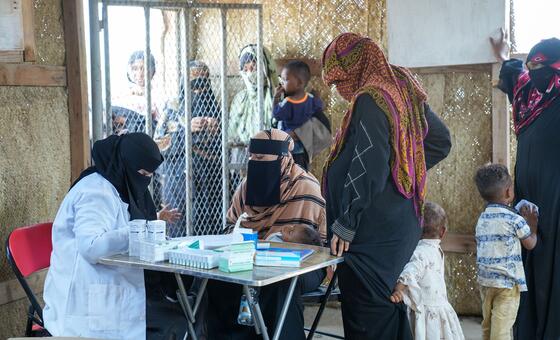
UNICEF is increasing its emergency operation with the aim of reaching up to 231,000 people. In Taiz, teams have assisted health facilities and supplied hygiene kits and water tanks. Additional water and hygiene materials have also been provided in Marib.
Nine mobile health and nutrition teams have been reassigned to displacement sites and affected areas in Aden, Marib and Taiz. These teams are intended to bring urgently needed services closer to families who may be unable to travel safely to fixed facilities.
Water and sanitation teams are also working to provide safe water and hygiene supplies to more than 200,000 people, while carrying out emergency repairs on damaged systems. Access to clean water is particularly important for displaced families living in crowded conditions, where disease risks can rise quickly when sanitation services fail.
Child-protection teams are offering psychosocial support and case-management services, including assistance for children who have been separated from relatives or are travelling without a parent or caregiver. They are also raising awareness of unexploded ordnance, a persistent threat in areas affected by fighting.
Families seek safety beyond Yemen
The impact of the escalation is being felt beyond Yemen’s borders. UNICEF is working with authorities in Djibouti to assist Yemeni families who crossed the Bab el-Mandeb Strait in search of safety. More than 2,000 people, including many children, have arrived after undertaking the dangerous sea journey.
The growing displacement crisis highlights the need for civilians to be protected and for humanitarian organizations to reach affected communities without obstruction. Safe access is essential for delivering food, healthcare, clean water, shelter supplies and protection services to families displaced by violence.
The UN Secretary-General has called on all sides to safeguard civilians, especially children, comply with international humanitarian law and allow humanitarian assistance to move safely and without impediment to people in need. For Yemen’s children, whose lives have already been shaped by more than a decade of conflict, those protections remain urgently needed.
Related Reading
Frequently Asked Questions
What is Yemen escalation displaces more than 57 000?
Yemen escalation displaces more than 57 000 is the main topic of this guide. The article explains the context, practical details, and next steps readers should understand.
Why does Yemen escalation displaces more than 57 000 matter?
Yemen escalation displaces more than 57 000 matters because readers are looking for a useful answer, not just a short summary. Good content should match search intent and help them decide what to do next.